
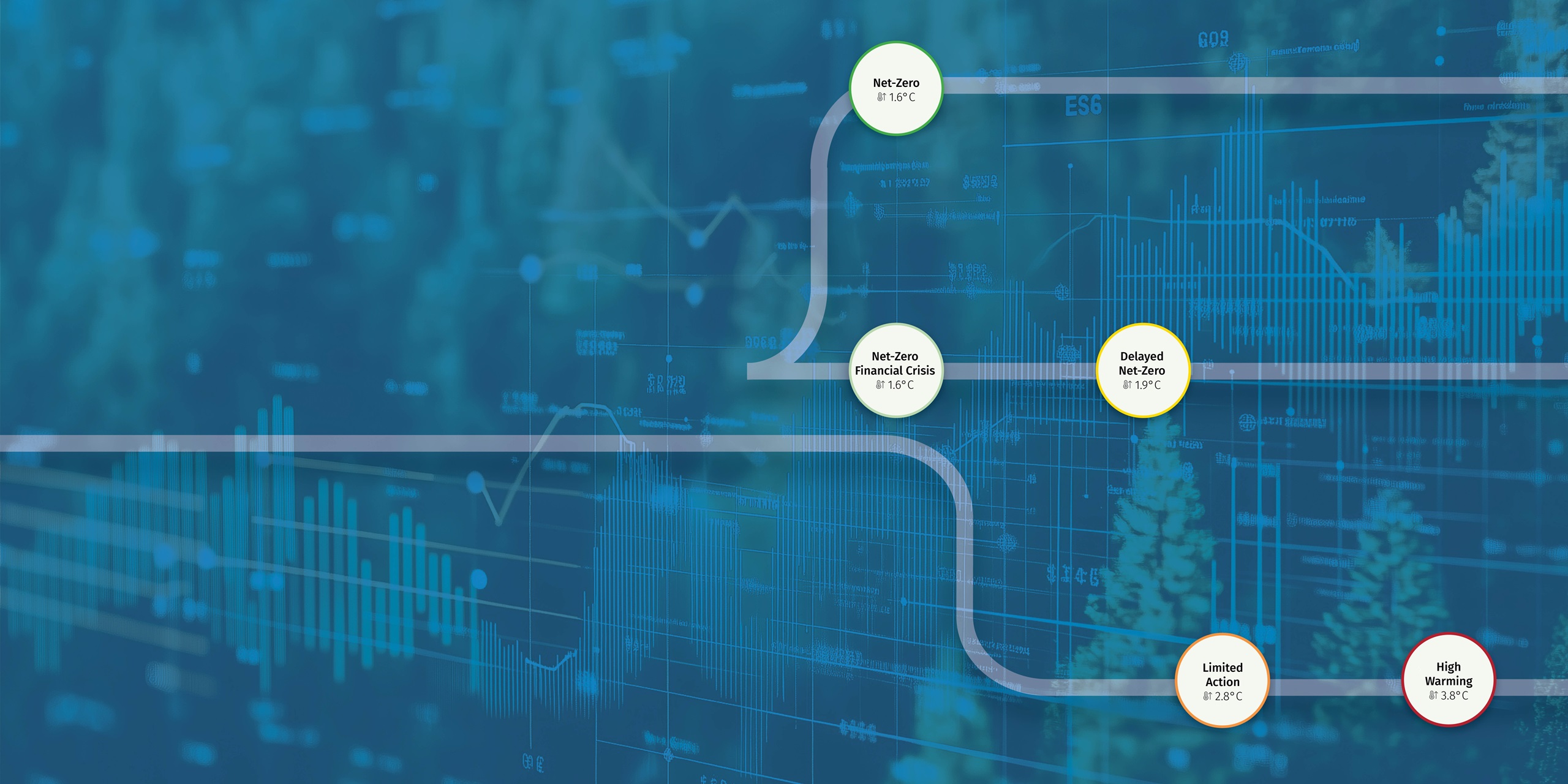

Our proprietary climate scenarios provides comprehensive financial insight and return impacts across all macroeconomies, asset classes and sectors driven from climate change-related transition, physical and market pricing risks.
The five climate scenarios are developed in partnership with Cambridge Econometrics, are used in combination with Economic Scenario Generator to quantify a portfolio’s climate risks as well as opportunities, across all asset classes and macroeconomic variables.
Net-Zero
Evaluates the risks and opportunities under a highly ambitious but orderly transition with climate adaptation
- Low-carbon policy pursuing 1.5°C and rapid technology transition
- Lower global temperatures enable adaptation and lower physical risks
- No market pricing-in shocks
Net-Zero Financial Crisis
Evaluates the resilence to sudden repricing, triggering market dislocation centered on high-emitting stocks
- Low-carbon policy pursuing 1.5°C and rapid technology transition
- Lower global temperatures enable adaptation and lower physical risks
- Sudden divestments in 2027 to align with the Paris Agreement goals have disruptive effects on financial markets with sudden repricing followed by stranded assets and a sentiment shock

Delayed Net-Zero
Evaluates impact when a sudden step-up in policy action in 2030 drives a sentiment shock in financial markets
- Limited additional action until 2030, when a highly ambitious set of low-carbon policies are introduced
- Partial adaptation limits short to medium term physical risks
- Financial markets price-in transition and physical risk in 2030 to align with ambitious policy announcement followed by stranded assets and a sentiment shock

Limited Action
Evaluates how falling short of meeting emissions targets and pledges would drive high exposure to physical risk
- Emission targets and commitments are not fully met
- High chronic and acute physical risks
- Financial markets price-in climate-related risks in 2030 and 2040 as the scale of future risks become more widely accepted and understood

High Warming
Evaluates implications of a future without any further policy action to limit climate change, triggering multiple climate tipping points and very severe physical risks
- No new low-carbon policies are enacted, but the transition progresses on economic grounds
- Catastrophic chronic and acute physical impacts
- Financial markets price-in climate-related risks in 2030 and 2040 as the scale of future risks become more widely accepted and understood
Alignment with IPCC CMIP scenarios
Our Ortec Finance Climate Scenarios are designed and updated to ensure alignment with the IPCC CMIP framework, taking into consideration key influencing factors such as the sensitivity of the climate to emissions, the level of dependence on negative emissions technologies and afforestation, and observed levels of global warming.
About ClimateMAPS
ClimateMAPS is Ortec Finance’s top down climate scenario analysis solution, developed in partnership with Cambridge Econometrics, realistically quantifies a financial institution’s portfolio climate risks as well as opportunities, across all asset classes and macroeconomic variables. Its comprehensive asset class, macroeconomic and sector insights help financial institutions understand how climate change can impact returns and can be integrated with traditional risk analysis and asset liability management frameworks.
Contact

Maurits van Joolingen
Managing Director, Climate Scenarios & Sustainability
Bronwyn Claire
Head of Research and APAC Lead, Climate Scenarios & Sustainability