

The summer of 2026 will be remembered as one of the most intense heat events ever experienced in Europe. Recent estimates from Allianz suggest that the extreme weather in 2026 has driven an €113bn loss in European output, amounting to around 0.5% of GDP1.
From an institutional investor perspective, what are the broader economic and financial implications of this unprecedented heat? Drought and wildfires can generate significant physical and economic damage, due to infrastructure strain, agricultural disruption, while also affecting productivity, supply chains, commodity prices and public finances.
How might these shocks feed through into economic growth and inflation? What could they ultimately mean for financial markets, asset valuations and investment risk across the investment horizon? And are there wider implications for a pension fund and insurers’ overall balance sheet?
How extreme heat is fueling persistent inflation further
Prolonged extreme temperatures have materially impacted agricultural productivity, with reduced rainfall, depleted soil moisture and water restrictions significantly reducing agricultural production and quality. Harvests were brought forward, while summer crop yields in Europe were estimated to have fallen by 14%2. These agricultural losses contribute to rising international food commodity prices, adding to existing inflationary pressures that are already being exacerbated by other factors, including the war in Iran.
How extreme heat is slowing GDP growth
In addition to reduced agricultural productivity, extreme heat has triggered thousands of wildfires across Europe, at a cost of billions of euros. A large proportion of these costs will be borne by affected insurers, businesses and households, disrupting economic activity and weighing on GDP growth.
Will extreme heat also affect interest rates?
The contribution of higher food prices to persistent inflationary pressures could increase the need for tighter monetary policy. Following recent interest rate increases by the European Central Bank and the US Federal Reserve, financial markets are closely monitoring whether similar policy tightening will be implemented by the Bank of England.
What does this mean for institutional investors?
The impacts of extreme heat on inflation and economic growth will have widespread direct and indirect effects on pension funds and insurers around the world.
Implications for pension fund investment portfolios
Persistent inflation exacerbated by extreme heat can further erode real purchasing power, meaning that retirement savings will provide less purchasing power over time. At the same time, weaker GDP growth resulting from heat-related disruptions increases systemic risk on portfolio returns through reduced economic activity, corporate earnings, and asset valuations. Pension systems therefore face a dual challenge: declining real returns and a rising cost of living, which can widen funding gaps and place increasing pressure on beneficiaries’ financial security.
Implications for insurance investment portfolios
Persistent inflation erodes real returns and policyholders’ purchasing power, while increasing the cost of insurance coverage and claim payouts. Lower GDP growth can also increase systemic risk across insurers’ investment portfolios. At the same time, more severe and frequent heat-related events, such as wildfires, can cause greater physical damage and larger insurance claims, increasing policy premiums and the payouts required from property and casualty insurers to support recovery and rebuilding. These pressures may ultimately exceed the capacity of traditional risk-transfer mechanisms, such as reinsurance, to fully absorb losses.
Together, these factors can challenge the insurance industry’s ability to provide affordable coverage and maintaining their overall business continuity.
Insurability concerns extend beyond insurers
If insurance becomes unaffordable or unavailable across large segments of the market, it could pose a significant systemic risk to the financial system. For institutional investors, insurability is therefore more than an insurance-sector issue; serving as an important indicator of emerging risks across property markets, mortgage portfolios, municipal finance and sovereign balance sheets. If these risks begin to be priced-in, they could have profound and cascading effects across multiple asset classes within an investment portfolio.
Understanding more on what rising physical risks, such as extreme heat, mean for institutional investors
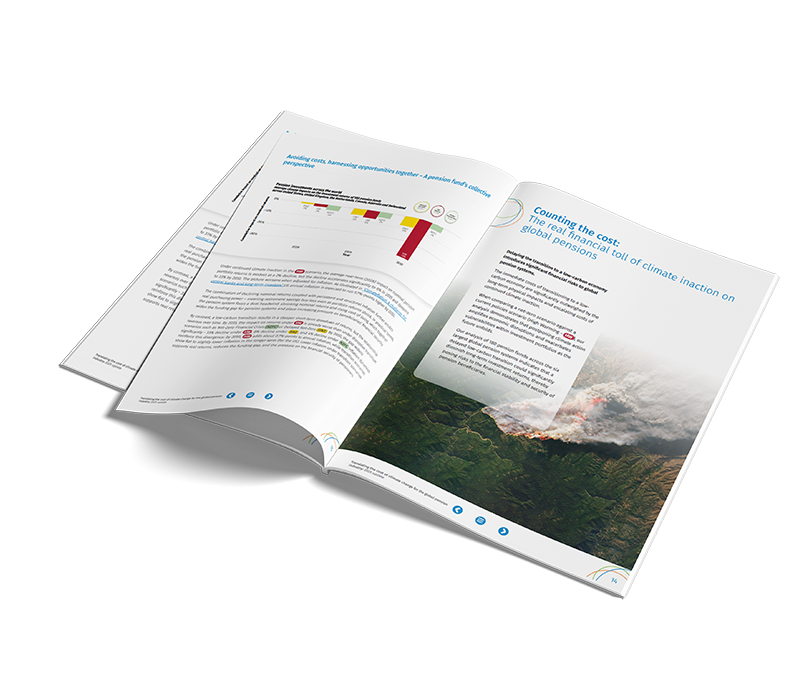
Download our annual climate risk analysis reports to explore how rising physical risks, such as extreme heat, could specifically affect the pension and insurance industries and the wider economy. Discover how the transition to a low-carbon economy could deliver long-term economic benefits by curbing ‘climateflation’ and reducing the risk of prolonged economic stagnation.
Translating the cost of climate change for the global pension industry:
Translating the cost of climate change for the European insurance industry:
More climate risk and sustainable finance insights
To receive the latest insights from our Climate Scenarios & Sustainability team on sustainable finance and climate risk management for financial institutions directly in your inbox, subscribe to our newsletter, Radar.

Contact

Sophie Heald
Senior Climate Specialist
Maurits van Joolingen
Managing Director, Climate Scenarios & SustainabilityRelated Insights
-
 15 October 2026Self-service reporting from P&A systems: Shaping the future of performance and attribution
Learn why self-service reporting from performance measurement and attribution systems strikes the right balance between control, consistency and efficiency.
-
 06 October 2026Quarterly Scenario webinar Q4 2026 - 'A New Cost of Capital? What Higher Rates and Resilient Growth Mean for Investors'
Join our October 27 Q4 outlook webinar to explore the future path of yields, the cost of capital and what that mean for investors.
-
 01 October 2026Advancing towards an integrated assessment of climate risk: Bridging top-down and bottom-up climate models
Join our event, jointly hosted with MSCI, to learn more about a pioneering approach to integrating top-down and bottom-up climate models.
-
 28 September 2026How could this year’s extreme heat impact institutional investment portfolios?
Explore what the recent unprecedent heat could potentially mean for a pension fund and insurer’s investment portfolio as well as their total balance sheets.
-
 28 September 2026How the ‘advice continuum’ is changing the game
The advice continuum is reshaping wealth management, from targeted support to holistic planning at scale.
-
 24 September 2026Webinar recording: Funding ratio attribution for asset owners under higher interest rates
Learn how to develop a funding/solvency attribution that encompasses a comprehensive view of the fund’s performance
-
 21 September 2026AP7 selects Ortec Finance's performance measurement and attribution solution - PEARL
Learn about why AP7 has selected PEARL to measure and analyze investment performance across its global equity and fixed income portfolios
-
15 September 2026Measuring and attributing decisions within an Investment Decision Process
Learn about our approach to measuring investment decisions that enables asset owners to understand decision’s contribution to the total fund performance.
-
 14 September 2026Overcoming performance measurement challenges in private markets
Explore a more robust approach to measuring and attributing performance across private assets-related decisions to achieve consistency and transparency