
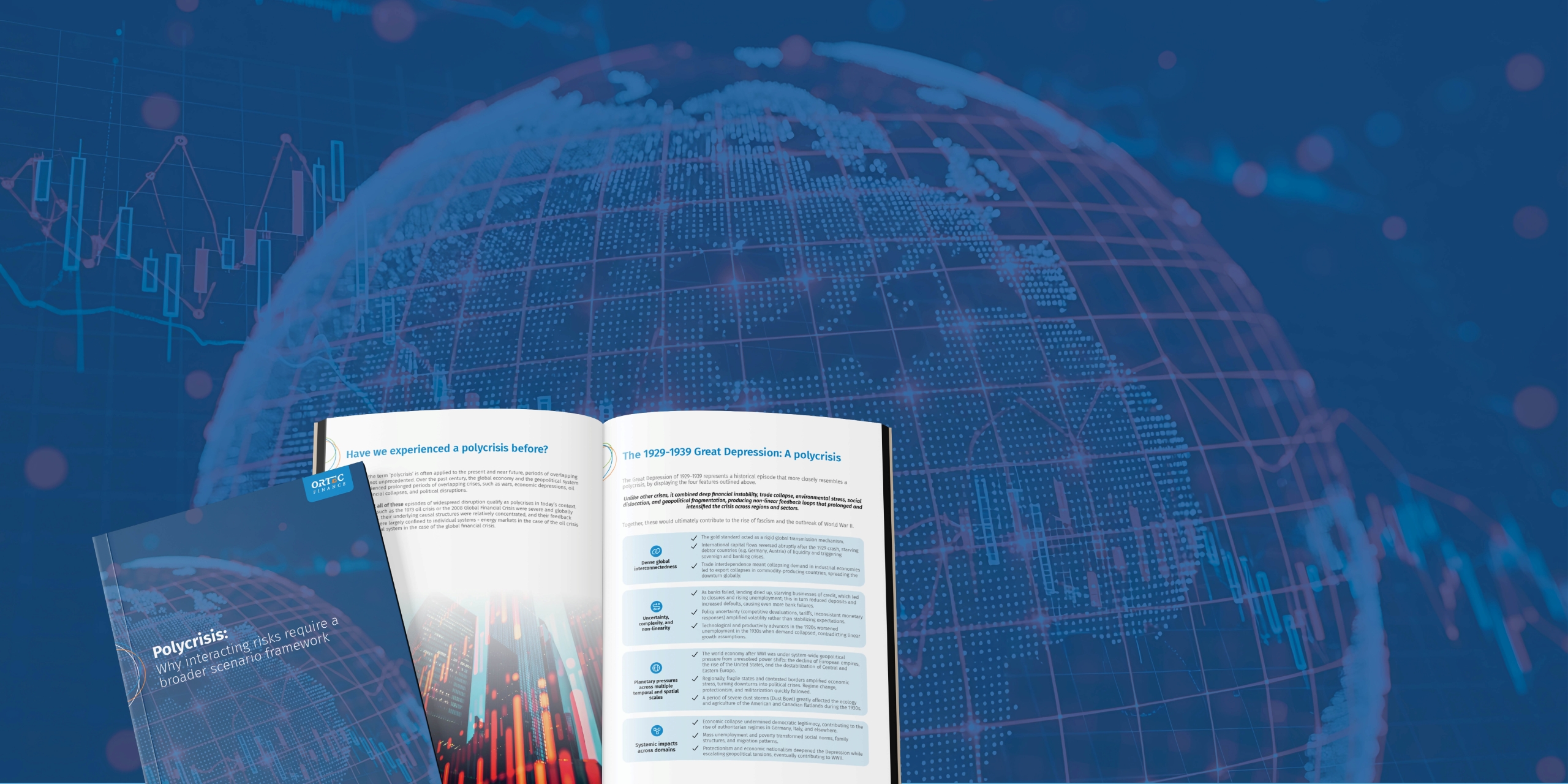
As the world continues to face prolonged uncertainty and escalating geopolitical, economic, and environmental risks, institutional investors are becoming increasingly exposed to interconnected and cascading threats that have significant implications for investment decision-making.
In this whitepaper, we explore how tail-risk events, including extreme scenarios such as a polycrisis, could affect institutional investors. We also provide guidance on strengthening risk management frameworks to help investors prepare for, respond to, and build portfolio resilience against an increasingly complex landscape.
Key takeaways

A polycrisis involves non-linear, widespread events that could trigger cascading, profound and far-reaching impacts on global financial markets

Polycrisis occurrences are very rare but have happened in the past, meeting the criteria of deep uncertainty, interconnectedness, environmental shocks, and systemic impacts.

A polycrisis in today’s environment would likely be significantly intensified by rapid digital and technological advancements

Stochastic scenarios based on realistic views and assumptions remain a vital starting point to preparing for a polycrisis

The fundamental uncertainty of a polycrisis that may not be fully captured by stochastic scenarios, should be addressed in combination with deterministic narrative-based scenarios to help investors better anticipate and prepare timely for its potential profound outcomes
Contact

Maurits van Joolingen
Managing Director, Climate Scenarios & Sustainability
Federico Andelsman Alvarez
Business SpecialistRelated Insights
-
 22 October 2026Towards more decision-useful climate risk insights
Explore four key, interconnected approaches for enabling climate risk insights generated from top-down climate scenarios to more actively inform investment decisions
-
 15 October 2026Self-service reporting from P&A systems: Shaping the future of performance and attribution
Learn why self-service reporting from performance measurement and attribution systems strikes the right balance between control, consistency and efficiency.
-
 06 October 2026Quarterly Scenario webinar Q4 2026 - 'A New Cost of Capital? What Higher Rates and Resilient Growth Mean for Investors'
Join our October 27 Q4 outlook webinar to explore the future path of yields, the cost of capital and what that mean for investors.
-
 01 October 2026Advancing towards an integrated assessment of climate risk: Bridging top-down and bottom-up climate models
Join our event, jointly hosted with MSCI, to learn more about a pioneering approach to integrating top-down and bottom-up climate models.
-
 28 September 2026How could this year’s extreme heat impact institutional investment portfolios?
Explore what the recent unprecedent heat could potentially mean for a pension fund and insurer’s investment portfolio as well as their total balance sheets.
-
 28 September 2026How the ‘advice continuum’ is changing the game
The advice continuum is reshaping wealth management, from targeted support to holistic planning at scale.
-
 24 September 2026Webinar recording: Funding ratio attribution for asset owners under higher interest rates
Learn how to develop a funding/solvency attribution that encompasses a comprehensive view of the fund’s performance
-
 21 September 2026AP7 selects Ortec Finance's performance measurement and attribution solution - PEARL
Learn about why AP7 has selected PEARL to measure and analyze investment performance across its global equity and fixed income portfolios
-
15 September 2026Measuring and attributing decisions within an Investment Decision Process
Learn about our approach to measuring investment decisions that enables asset owners to understand decision’s contribution to the total fund performance.