

Ortec Finance, a leading provider of top-down climate scenario analysis for financial institutions, today released its updated 2026 climate scenarios which highlight the rising impact of climate risk on insurability and governments’ ability to access finance through sovereign debt markets.
“Physical climate-related risks are increasing the chances of triggering an insurability crisis, with the effects extending far beyond insurers to threaten overall global financial stability and sovereign debt markets,” said Maurits van Joolingen, Managing Director, Climate Scenarios & Sustainability at Ortec Finance. “In such a scenario, insurance premiums will become unaffordable, leaving many uninsured and governments left to fill the gap though sovereign debt issuance, acting as the insurer of last resort.”
Under two of Ortec Finance’s latest higher warming scenarios, nearly 30% of the US population will be living in a state where the median household is unable to afford insurance by 2050, rising to 50% by 2080. Insurers have already started withdrawing cover from high-risk areas such as California and Florida in the US as well as Australia.
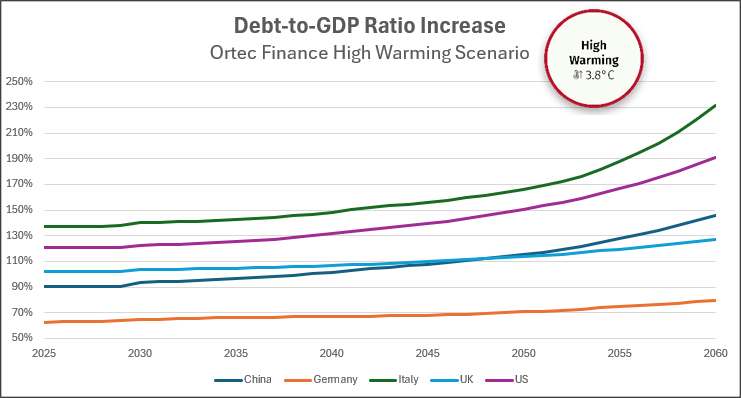
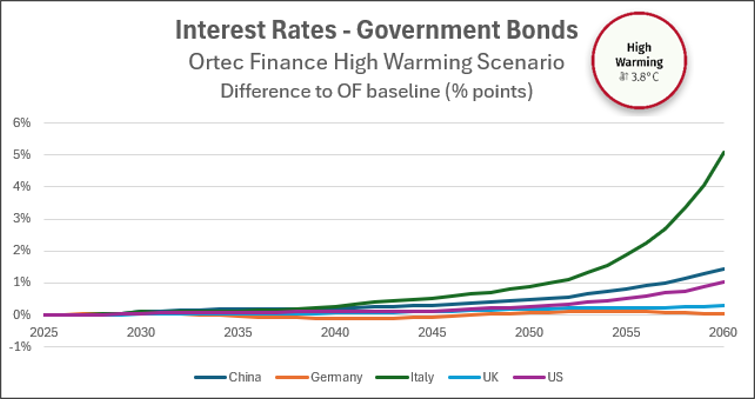
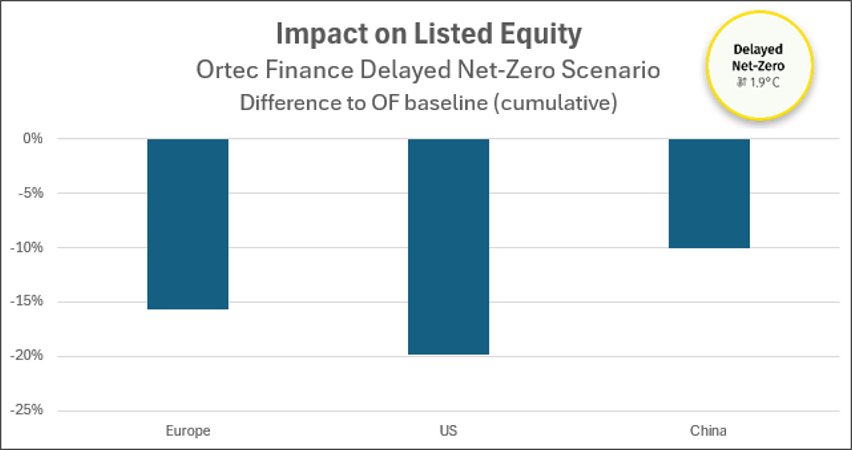
Delayed transition to net zero signals financial market disruption and sustained macroeconomic strain
Ortec Finance’s annual analysis continues to indicate that achieving net zero by 2050 is no longer feasible, as highlighted in its 2025 update, pointing investors to focus towards its delayed net-zero scenario.
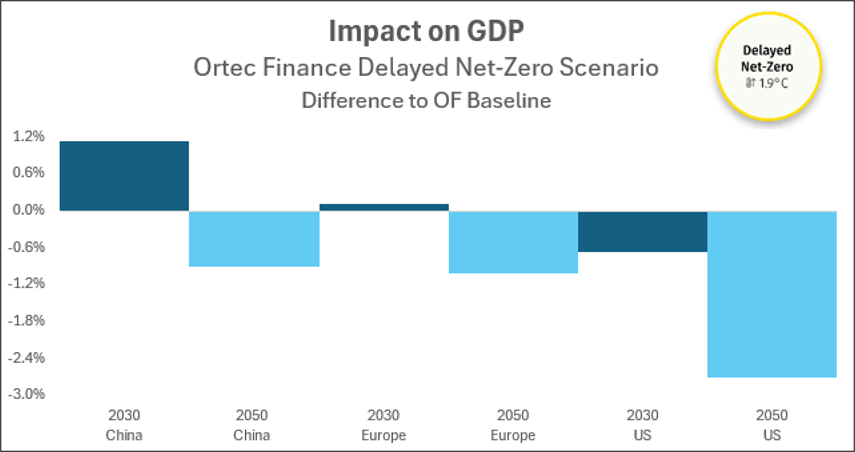
Commenting on the latest release of scenarios, Sophie Heald, Senior Climate Specialist at Ortec Finance, said: “Climate risk is systemic, but it doesn’t impact all regions equally. This divergence underscores the need for region-sensitive investment strategies. We are proud to present the expansion of our coverage, which now includes the impact on sovereign debt. In our view, this has been an important missing link in the total portfolio assessment of climate change. Our framework enables evaluation of how physical and transition risks influence national GDP levels, their subsequent impact on debt-to-GDP ratios, and how these changes may affect interest rates.”
* The Ortec Finance Climate Scenarios are created as deviations from a baseline scenario (OF baseline) that reflects public reference climate scenarios in the 2°C to 3°C global warming range.
Climate Scenarios & Sustainability 2026 Ortec Finance Climate Scenarios
Contact