
The world is currently experiencing a phase of heightened economic uncertainty, driven by transitions in technology, demographics, geopolitics, and the environment. Yet, these shifts do not seem reflected in current financial market conditions, except during intermittent periods of elevated market volatility.
For institutional investors to adequately assess how to interpret and respond to this situation, it is essential to first recognize the differences between these two dimensions, and subsequently how these inform investment decision-making.
Economic uncertainty explained: What it is and how it can be measured
Economic uncertainty is a risk indicator that arises from uncertainty in economic narratives and policy discussions. It can be measured by the World Uncertainty Index (WUI), which highlights broader systemic concerns.
Financial risk explained: What it is and how it can be measured
Financial risk is often captured by indicators such as a risk indicator derived from short-term volatility in financial markets. One example is the VIX which highlights equity market responses primarily to near-term, price-relevant shocks.
Today’s economic uncertainty and financial risk
Since its inception in 1990, the WUI reached an all-time high in 2025, indicating perceived global risks have increased significantly, potentially reflecting rising economic uncertainty. On the other hand, financial markets have exhibited episodic market volatility over the past two years, as captured by the CBOE Volatility Index, with sharp spikes that quickly normalize.
World Uncertainty Index 1990 (Q1) to 2026 (Q1)
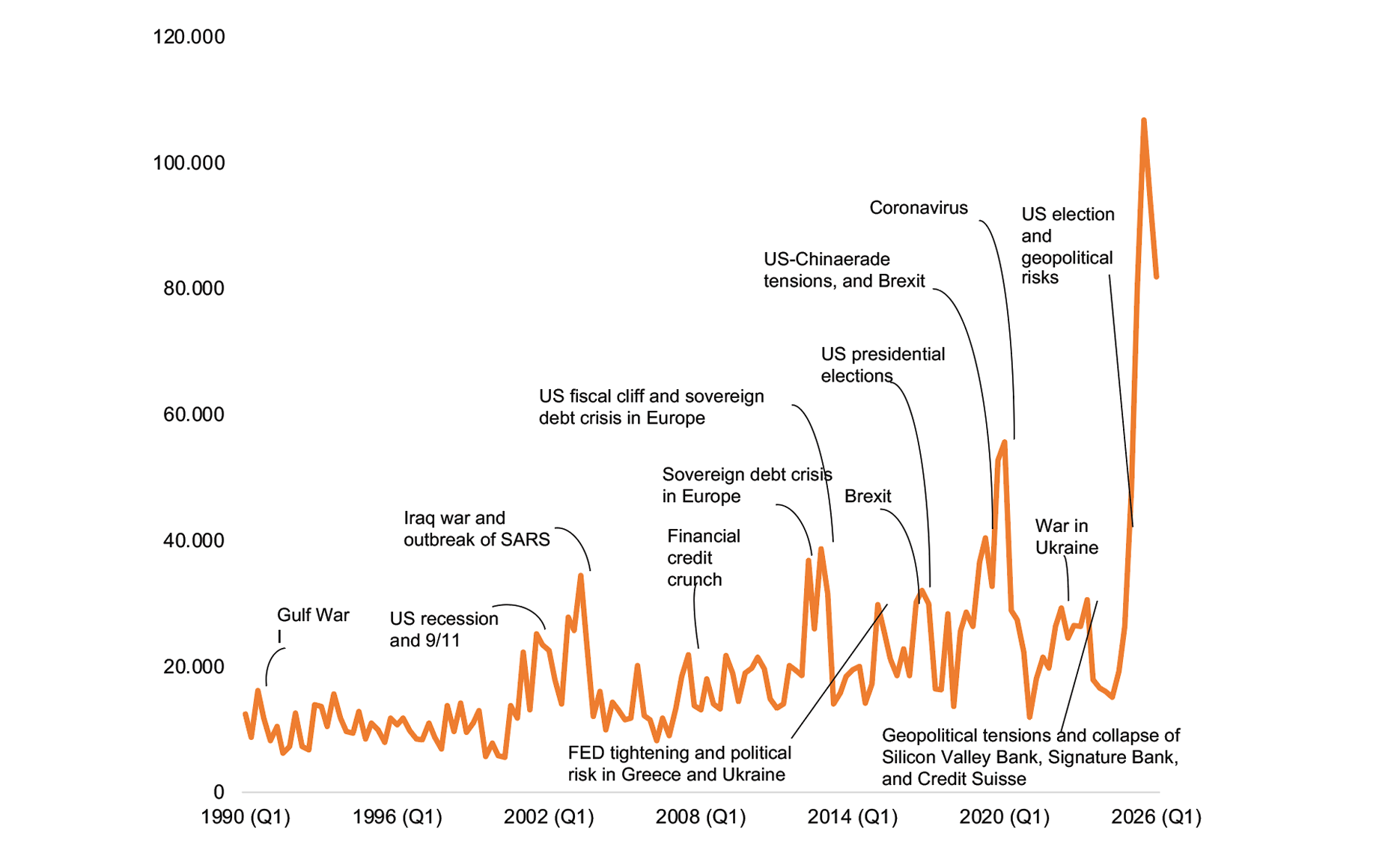
Figure 1: World Uncertainty Index1 since 1990. 2025 levels were at an all-time high.
CBOE Volatility Index January 2 1990 - April 30 2026
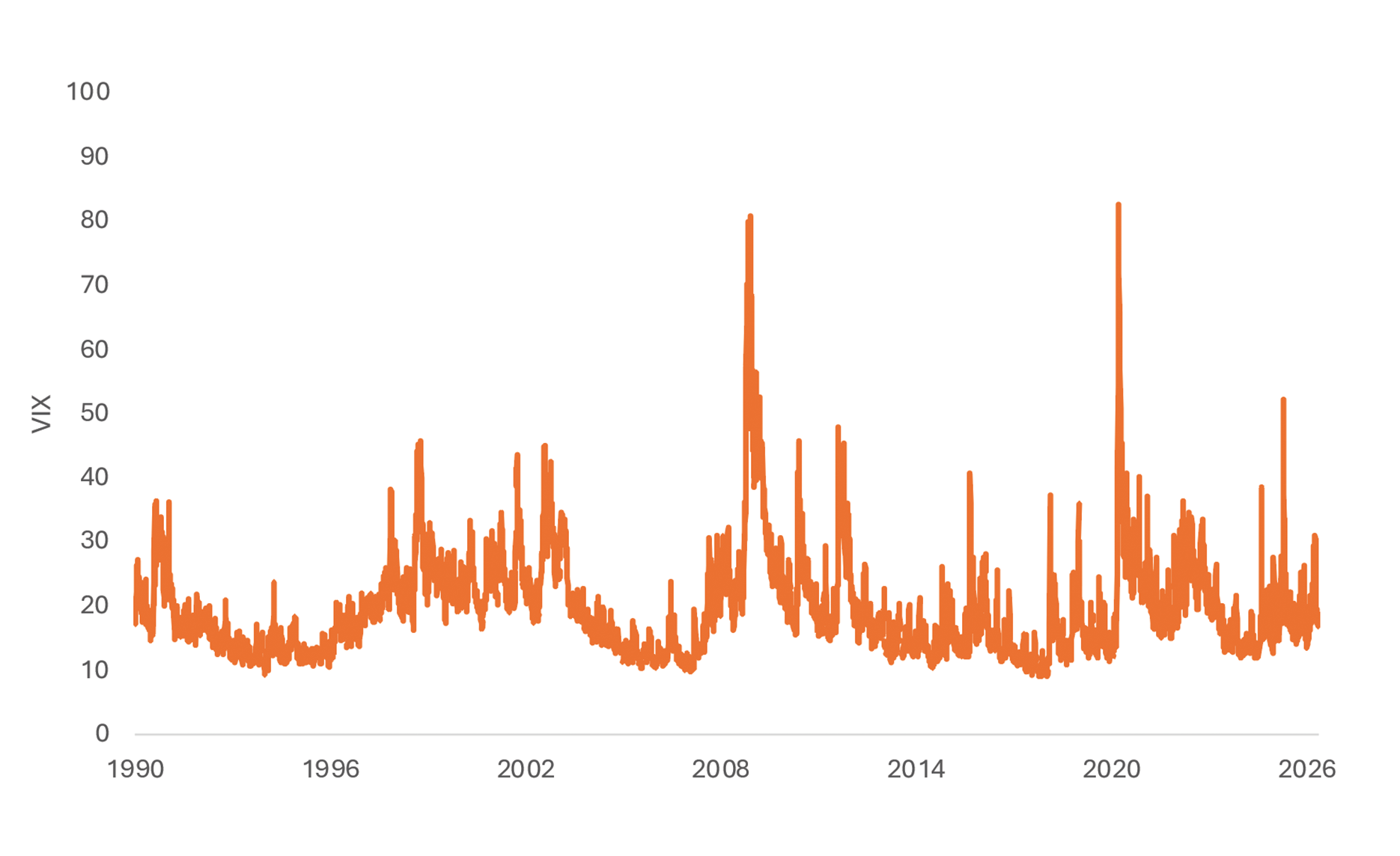
Figure 2: CBOE Volatility Index2 since 1990
This apparent disconnect between increased uncertainty and relative stable financial risks presents a unique scenario and challenge for investors:
- Subjective uncertainty remains persistently high due to structural and geopolitical shifts – ‘Many things could go wrong’
- Volatility remains moderate on average. Markets only temporarily react when specific triggers materialize – ‘Markets occasionally believe something will go wrong soon’
Such a scenario, particularly against a backdrop of dense global interconnectedness, uncertainty with complex non-linear feedback loops, systemic impacts, and planetary structural strains, may lead to a prolonged period of stagnating or negative economic growth, persistent high inflation, and rising uncertainty in financial markets.
In an extreme case, this could evolve into a polycrisis, in which interconnected and cascading risks amplify one another, serving as the ultimate test of institutional investors’ confidence and trust, leading to vastly different market responses from previous crises.
Understanding a polycrisis in the institutional investment context: Learn more
To further understand the risks posed by an extreme scenario such as polycrisis and how they affect investment decision-making and risk management frameworks, we invite you download our whitepaper ‘Polycrisis and institutional investment: Why interacting risks require a broader scenario framework’.
Footnotes
1 Ahir, H, N Bloom, and D Furceri (2022), “World Uncertainty Index”, NBER Working Paper.
2 Chicago Board Options Exchange, CBOE Volatility Index: VIX [VIXCLS], retrieved from FRED, Federal Reserve Bank of St. Louis; https://fred.stlouisfed.org/series/VIXCLS, May 29, 2026.
Contact

Maurits van Joolingen
Managing Director, Climate Scenarios & Sustainability
Federico Andelsman Alvarez
Business SpecialistRelated Insights
-
 22 October 2026Towards more decision-useful climate risk insights
Explore four key, interconnected approaches for enabling climate risk insights generated from top-down climate scenarios to more actively inform investment decisions
-
 15 October 2026Self-service reporting from P&A systems: Shaping the future of performance and attribution
Learn why self-service reporting from performance measurement and attribution systems strikes the right balance between control, consistency and efficiency.
-
 06 October 2026Quarterly Scenario webinar Q4 2026 - 'A New Cost of Capital? What Higher Rates and Resilient Growth Mean for Investors'
Join our October 27 Q4 outlook webinar to explore the future path of yields, the cost of capital and what that mean for investors.
-
 01 October 2026Advancing towards an integrated assessment of climate risk: Bridging top-down and bottom-up climate models
Join our event, jointly hosted with MSCI, to learn more about a pioneering approach to integrating top-down and bottom-up climate models.
-
 28 September 2026How could this year’s extreme heat impact institutional investment portfolios?
Explore what the recent unprecedent heat could potentially mean for a pension fund and insurer’s investment portfolio as well as their total balance sheets.
-
 28 September 2026How the ‘advice continuum’ is changing the game
The advice continuum is reshaping wealth management, from targeted support to holistic planning at scale.
-
 24 September 2026Webinar recording: Funding ratio attribution for asset owners under higher interest rates
Learn how to develop a funding/solvency attribution that encompasses a comprehensive view of the fund’s performance
-
 21 September 2026AP7 selects Ortec Finance's performance measurement and attribution solution - PEARL
Learn about why AP7 has selected PEARL to measure and analyze investment performance across its global equity and fixed income portfolios
-
15 September 2026Measuring and attributing decisions within an Investment Decision Process
Learn about our approach to measuring investment decisions that enables asset owners to understand decision’s contribution to the total fund performance.