

Institutional investors are increasingly turning to the Total Portfolio Approach (TPA) to improve their investment decision‑making. Its appeal is clear: it encourages decisions to be made from the perspective of the total fund, rather than through separate asset-class silos. In doing so, TPA can improve the alignment between objectives, risk usage, liquidity, implementation costs and long‑term outcomes.
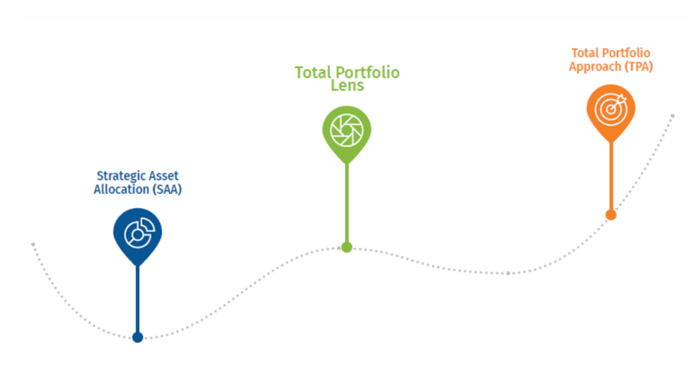
At the same time, many funds experience a gap between the conceptual appeal of TPA and the practical challenges of implementation. A fully developed TPA framework often requires changes to governance, investment processes and decision rights, incentive structures and data infrastructure. For many institutions, adopting such a model in one step is neither realistic nor necessary.
That does not mean progress has to wait. In practice, many of the benefits associated with TPA can be introduced gradually while leaving the existing structures largely intact. This is where a Total Portfolio Lens (TPL) can be practically useful – not as a replacement but as a way to make current decision-making more holistic, outcome-oriented, flexible and connected to the fund’s mission.
Using the reference portfolio more deliberately
A natural starting point is the role of the reference portfolio. Most institutional investors already have a strategic benchmark, policy portfolio or reference portfolio. However, its role in day-to-day decision‑making is often limited. It may be used for performance measurements or long-term policy review, but less often as an active anchor for total fund decisions.
Within a TPA context, the reference portfolio serves as an anchor for total‑fund risk and return. It helps investment teams and boards to assess whether proposed changes improve the overall portfolio, rather than simply looking attractive within one asset class.
By explicitly using the reference portfolio in discussions around portfolio changes, funds gain clearer insight into where active risk is taken and how individual decisions contribute to total‑fund outcomes. This does not require abandoning the existing SAA framework. The reference portfolio can remain the strategic anchor, while allowing more explicit discussion on where flexibility is available. These discussion points could be expressed through a volatility range around the SAA, tracking error or just the bandwidths defined in the investment policy statement.
Risk is not constant over time and this matters for strategic portfolio decisions. n practice, the risk of a given asset mix fluctuates with market conditions, valuation levels, volatility and correlations. A static view of risk can therefore be misleading as the same strategic allocation may embed very different levels of downside risk, concentration or liquidity stress across economic regimes. Using a reference portfolio within a SAA context helps to explicitly recognize this time‑varying nature of risk. While the reference portfolio provides a stable strategic anchor, any deviations from its paremeters make changes in risk more transparent and measurable as market conditions evolve. Boards and investment committees can then discuss whether additional risk is being taken deliberately and efficiently, rather than implicitly through changing market dynamics. In that sense, combining the reference portfolio with a SAA framework combines long‑term discipline with a more realistic, dynamic view on risk.
From risk limits to a total‑fund risk budget
A second practical step is to change the way risk is governed and discussed. Traditional frameworks typically express risk through asset‑class‑specific limits. While effective from a control perspective, this can obscure whether risk is being used efficiently at total‑fund level.
Introducing a total‑fund risk budget can improve this discussion. Instead of focusing on compliance with individual limits, the emphasis moves to whether a decision represents a sensible use of the available risk budget given the fund’s objectives. This change often improves the quality of discussions at board and investment committee level. Trade‑offs between different decisions become clearer and risk often becomes a steering variable rather than a constraint. This approach allows boards and investment committees to compare decisions across asset classes, strategies and time horizons. For example, an increase in illiquid assets, a change in hedge ratio, or a tilt toward higher-return assets can be assessed against the same total fund risk framework. Funds often have guardrails at the allocation group level but allow flexibility within groups to optimize the use of risk budgets.
This can often be implemented with limited changes to governance arrangements. The SAA remains the anchor and existing limits remain in place but decision-making becomes more integrated. The result is a more mature risk conversation – less focused on isolated limits and more focused on whether the total portfolio is actually using risk in the right places.
Under a total-fund risk budget, a change in hedge ratio, an increase in private infrastructure exposure or an opportunistic tilt toward growth assets can be evaluated within the same risk framework rather than in separate policy discussions.
Exploring optimization in a pragmatic way
Optimization is often closely associated with TPA but this can create the impression that its application requires a complete redesign of the investment framework or the use of highly complex quantitative techniques. While optimization has indeed evolved significantly in recent years, these advances have primarily increased its practical relevance rather than its complexity.
Modern optimization techniques can help institutions explore portfolio choices at total‑portfolio level while explicitly accounting for real‑world constraints. These constraints may include liquidity, risk budgets, implementation feasibility, regulatory requirements, sustainability targets and private market pacing limits.
The value of TPA is that it broadens the decision space, allowing investment teams and boards to compare alternative portfolio designs and understand the trade-offs between risk, return, liquidity, resilience or sustainability.
The above fits naturally within a Total Portfolio Lens. The existing SAA or reference portfolio remains the strategic anchor, while optimization is used as an analytical layer around it. It can show which changes are worth considering, which constraints are most binding and where additional flexibility could improve total-fund outcomes. In this way, optimization becomes a decision support tool that makes choices more transparent, without forcing the organization into a full TPA redesign.
Making liquidity part of the total‑portfolio discussion
Liquidity is another area where a TPA perspective can be introduced incrementally. In many frameworks, liquidity is treated mainly as a constraint: a minimum cash buffer, a limit on illiquid assets, or a stress test requirement. A total portfolio perspective goes further. It treats liquidity as part of portfolio design and as a source of future flexibility. The question is not only whether the fund can meet near-term cash needs but also whether it has enough flexibility to act when markets move, rebalance when opportunities arise, and avoid forced selling under stress.

Scenario analysis is particularly useful here. By assessing liquidity under different market environments, funds gain better insights into understanding the interaction between private markets, capital calls, benefit payments, collateral needs and rebalancing requirements. This analysis supports more balanced discussions about illiquid investments and helps to avoid reactive decisions during periods of market stress. This step is mainly analytical in nature and can usually be implemented without changing the formal investment strategy. It supports better-informed decision-making by giving investment teams and boards clearer insight into trade‑offs, especially for funds with growing allocations to private markets or more complex cash-flow needs.
Liquidity then becomes part of the total portfolio conversation: not simply a restriction on return-seeking investments, a condition for resilience, flexibility and long-term mission delivery.
Governance lessons from practice
Experience from recent governance‑focused work shows that progress toward TPA is not mainly about analytical sophistication. In practice, many institutions already have access to advanced models, data and reporting. The real question is often how decisions are framed, delegated and reviewed in a way that supports total fund thinking. A recurring lesson is that boards benefit most from clarity, not complexity. Effective TPA governance requires a limited number of well‑defined reference points that connect portfolio decisions to the fund’s mission, risk appetite and long‑term objectives. When these reference points are clear, boards can focus on direction and oversight and the investment team can, in turn, assess the implementation choices within the agreed guardrails.
Another important insight is that most institutions move toward TPA gradually (and might just stop somewhere along the way). Hybrid frameworks are common. A fund may keep its SAA as the formal policy anchor, while introducing more flexibility around active risk, liquidity management, scenario analysis or cross-asset decision-making. This phased approach reduces organizational friction and allows experience to build over time. Some institutions may eventually move toward a fuller TPA model. Others may stop at an intermediate point because that is what best fits their governance structure. The important point is that progress does not have to be binary. In this regard, TPA is not an end state but a journey.
Finally, governance discussions increasingly recognize the intertemporal nature of investment decisions. Liquidity, flexibility and the ability to respond to future market conditions are not purely technical considerations. They are central to safeguarding the fund’s long‑term mission and therefore belong firmly within the governance domain.
Gradual progress toward a more integrated approach
For many institutional investors, TPA represents a direction rather than an immediate end state. The most practical route toward TPA is not a full redesign. It is a sequence of focused improvements that make existing decision-making more holistic and more outcome oriented.
Using the reference portfolio more deliberately, introducing a total fund risk budget, applying optimization pragmatically and bringing liquidity into the total portfolio discussion are all examples of quick wins. Each can be implemented within or alongside the existing SAA framework. Each improves the quality of decisions without requiring immediate structural change.
Our experience shows that this gradual approach delivers tangible benefits early on and allows funds to benefit from selected elements of TPA in a way that fits their objectives and governance structure.
In that sense, the most effective first step toward TPA may not be to redesign the whole investment model. It may be to apply a Total Portfolio Lens to the decisions already being made today.
Download our brochure to learn more about our Total Portfolio Lens approach
Download our brochureRelated Insights
-
 15 October 2026Self-service reporting from P&A systems: Shaping the future of performance and attribution
Learn why self-service reporting from performance measurement and attribution systems strikes the right balance between control, consistency and efficiency.
-
 06 October 2026Quarterly Scenario webinar Q4 2026 - 'A New Cost of Capital? What Higher Rates and Resilient Growth Mean for Investors'
Join our October 27 Q4 outlook webinar to explore the future path of yields, the cost of capital and what that mean for investors.
-
 01 October 2026Advancing towards an integrated assessment of climate risk: Bridging top-down and bottom-up climate models
Join our event, jointly hosted with MSCI, to learn more about a pioneering approach to integrating top-down and bottom-up climate models.
-
 28 September 2026How could this year’s extreme heat impact institutional investment portfolios?
Explore what the recent unprecedent heat could potentially mean for a pension fund and insurer’s investment portfolio as well as their total balance sheets.
-
 28 September 2026How the ‘advice continuum’ is changing the game
The advice continuum is reshaping wealth management, from targeted support to holistic planning at scale.
-
 24 September 2026Webinar recording: Funding ratio attribution for asset owners under higher interest rates
Learn how to develop a funding/solvency attribution that encompasses a comprehensive view of the fund’s performance
-
 21 September 2026AP7 selects Ortec Finance's performance measurement and attribution solution - PEARL
Learn about why AP7 has selected PEARL to measure and analyze investment performance across its global equity and fixed income portfolios
-
15 September 2026Measuring and attributing decisions within an Investment Decision Process
Learn about our approach to measuring investment decisions that enables asset owners to understand decision’s contribution to the total fund performance.
-
 14 September 2026Overcoming performance measurement challenges in private markets
Explore a more robust approach to measuring and attributing performance across private assets-related decisions to achieve consistency and transparency