

For a UK DB scheme with a strong funding position, there are effectively three routes for the scheme to reach their endgame objectives:
1. Immediate buy-in/out with a bulk annuity insurer
In this route, the scheme transfers its assets and liabilities of the pension scheme is transferred to a life insurance company. The insurer then takes full responsibility for paying members’ benefits when they fall due. This approach offers sponsors and trustees a clean and definitive risk transfer, locking in certainty and removing long-term funding risks.
2. Buy-in with a captive insurer set up by the sponsoring employer
This option mirrors the mechanics of a traditional bulk annuity approach above, with one key distinction: the insurer is owned by the scheme’s sponsor. By transferring the scheme’s liabilities into a sponsor-backed captive insurer, companies can retain greater control and potentially capture economic value that would be typically secured by third-party insurers—while still delivering security for members.
3. Running on the scheme with the flexibility to buy-in/out later
This option enables the scheme to continue operating under its existing structure, often over a number of years, with the aim of generating surplus relative to a prudent funding basis. The upcoming regulatory changes are expected to improve the ability to extract surplus, making run on more attractive for sponsors and trustees. How the surplus is shared between the sponsor and members would be specific to each scheme, but it would enable sponsors to access “trapped surplus” and the members to receive an uplift of their benefits.
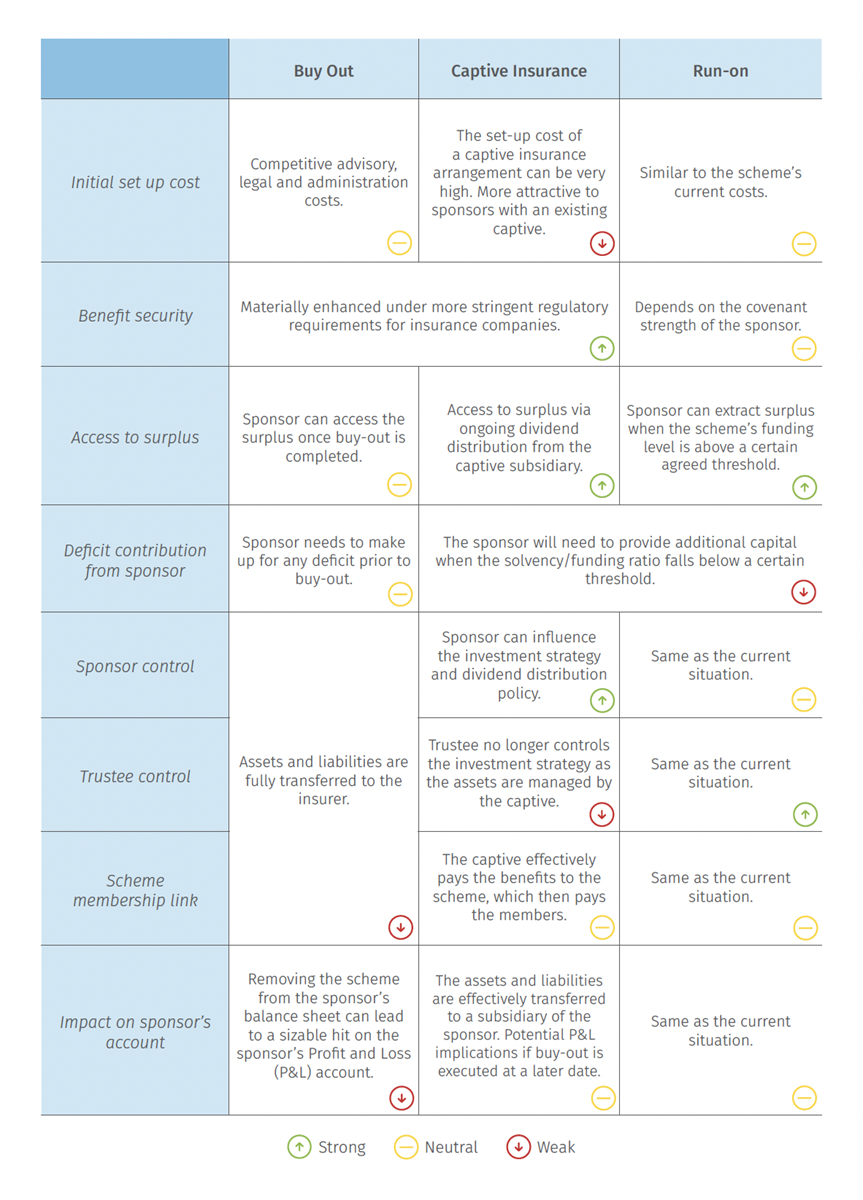
The table summarizes the key pros and cons of each endgame option.
Interested to know more?
This article is the second in our series on rethinking the endgame for UK defined benefit pension schemes,
Download the whitepaper for a full comparison of endgame options where we evaluate the options using GLASS.
Or access the full series, here
Contact

Ashish Doshi
Head of Insurance and Asset Management
Selina Wang
Senior Consultant - Insurance Solutions
Ben Hudson
Senior ConsultantRelated Insights
-
 06 October 2026Quarterly Scenario webinar Q4 2026 - 'A New Cost of Capital? What Higher Rates and Resilient Growth Mean for Investors'
Join our October 27 Q4 outlook webinar to explore the future path of yields, the cost of capital and what that mean for investors.
-
 01 October 2026Advancing towards an integrated assessment of climate risk: Bridging top-down and bottom-up climate models
Join our event, jointly hosted with MSCI, to learn more about a pioneering approach to integrating top-down and bottom-up climate models.
-
 28 September 2026How could this year’s extreme heat impact institutional investment portfolios?
Explore what the recent unprecedent heat could potentially mean for a pension fund and insurer’s investment portfolio as well as their total balance sheets.
-
 28 September 2026How the ‘advice continuum’ is changing the game
The advice continuum is reshaping wealth management, from targeted support to holistic planning at scale.
-
 24 September 2026Webinar recording: Funding ratio attribution for asset owners under higher interest rates
Learn how to develop a funding/solvency attribution that encompasses a comprehensive view of the fund’s performance
-
 21 September 2026AP7 selects Ortec Finance's performance measurement and attribution solution - PEARL
Learn about why AP7 has selected PEARL to measure and analyze investment performance across its global equity and fixed income portfolios
-
15 September 2026Measuring and attributing decisions within an Investment Decision Process
Learn about our approach to measuring investment decisions that enables asset owners to understand decision’s contribution to the total fund performance.
-
 14 September 2026Overcoming performance measurement challenges in private markets
Explore a more robust approach to measuring and attributing performance across private assets-related decisions to achieve consistency and transparency
-
 27 August 2026Total Portfolio Lens: A five-part webinar series
Learn how to apply the TPA approach without redesigning your entire investment model.