

When talking about DB pension scheme endgame options in the UK, there has up to now only been one option - securing a buy-out with an insurer. While this remains a viable and often appropriate option, regulation changes are opening the door to alternative, non-insurer-led strategies.
How recent regulatory developments are changing surplus access
- Surplus extraction allowance - UK regulation changes are set to unlock billions of pounds currently being held as surplus of DB pensions schemes. The means extracted surplus can be funded to members, sponsors or both, making it of high interest to all stakeholders.
- Captive insurance frameworks – while this endgame option has previously been seen as a route for a select few pension schemes in the UK, interest in surplus extraction is making this a viable option to be considered more widely than before as it is a more secure way of accessing surplus than just pure run-on.
Growing interest in alternative endgame strategies
For a pension scheme in the UK, there is no longer one obvious endgame option, and the developments discussed above have opened the door to a number of options.
For the DB pension schemes that find themselves falling short in respect to their funding position (relative to buy-in) and being unlikely to make up the deficit, the endgame options may be limited. However, DB Superfunds can offer an alternative bridge option for these schemes to ultimately achieve buy-out.
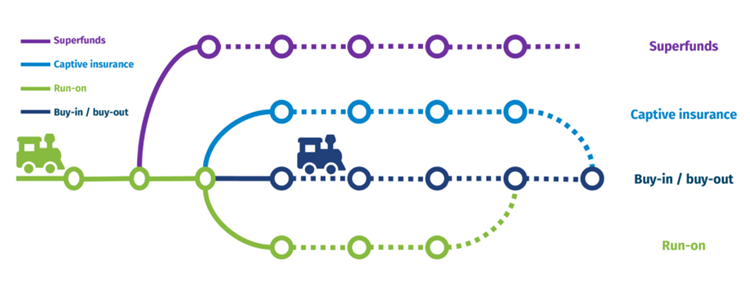
Why buy-out is no longer automatically the “right” answer
With these new endgame options available, the DB endgame is no longer one-size-fits-all. Trustees and sponsors now have additional considerations to take into account when choosing their pension schemes endgame:
- Accessing surplus - As of early 2026, there is around £260 billion* in surplus that is, under the “classic” route, being handed over to insurers as part of a buy-out transaction.
- Maintaining control – There are now endgame options offering the ability to maintain relationships between Trustees/sponsors and members of a scheme.
Trustees and sponsors need to weigh each option carefully, balancing member security against economic value, while keeping a close eye on long-term consequences, particularly the irreversible nature of a buy-in or buy-out.
A key part of this evaluation is to understand the risks, both upside and downside, which a capable stochastic ALM tool will be able to do.
*Taken as at February 2026, measured on a S179 basis.
Source: https://www.ppf.co.uk/ppf-7800-index
Interested to know more?
This article is the first in our series on rethinking the endgame for UK defined benefit pension schemes,
Download the whitepaper for a full comparison of endgame options where we evaluate the options using GLASS.
Or access the full series, here
Contact

Ashish Doshi
UK Insurance Lead
Selina Wang
Senior Consultant - Insurance Solutions
Ben Hudson
Senior ConsultantRelated Insights
-
 06 October 2026Quarterly Scenario webinar Q4 2026 - 'A New Cost of Capital? What Higher Rates and Resilient Growth Mean for Investors'
Join our October 27 Q4 outlook webinar to explore the future path of yields, the cost of capital and what that mean for investors.
-
 01 October 2026Advancing towards an integrated assessment of climate risk: Bridging top-down and bottom-up climate models
Join our event, jointly hosted with MSCI, to learn more about a pioneering approach to integrating top-down and bottom-up climate models.
-
 28 September 2026How could this year’s extreme heat impact institutional investment portfolios?
Explore what the recent unprecedent heat could potentially mean for a pension fund and insurer’s investment portfolio as well as their total balance sheets.
-
 28 September 2026How the ‘advice continuum’ is changing the game
The advice continuum is reshaping wealth management, from targeted support to holistic planning at scale.
-
 24 September 2026Webinar recording: Funding ratio attribution for asset owners under higher interest rates
Learn how to develop a funding/solvency attribution that encompasses a comprehensive view of the fund’s performance
-
 21 September 2026AP7 selects Ortec Finance's performance measurement and attribution solution - PEARL
Learn about why AP7 has selected PEARL to measure and analyze investment performance across its global equity and fixed income portfolios
-
15 September 2026Measuring and attributing decisions within an Investment Decision Process
Learn about our approach to measuring investment decisions that enables asset owners to understand decision’s contribution to the total fund performance.
-
 14 September 2026Overcoming performance measurement challenges in private markets
Explore a more robust approach to measuring and attributing performance across private assets-related decisions to achieve consistency and transparency
-
 27 August 2026Total Portfolio Lens: A five-part webinar series
Learn how to apply the TPA approach without redesigning your entire investment model.