

For pension schemes where buy-out might be prohibitive due to cost or size, or where the sponsor wants/has the capability to retain some economic exposure, a captive insurance arrangement may present a viable alternative.
This approach enables the trustees to transfer all of the risks to an insurance structure, while accommodating the strategic preferences of the sponsor. The sponsor retains the risk through a buy-in via a captive insurer arrangement. It benefits from retaining the surplus, and equally, may still be liable if a deficit appears.
This is an attractive solution for the sponsor as it can enable a regular profit stream over the lifetime of the pension scheme, unlocking value that itself has been created through funding over time. The cash inflow comes through a release of profits from investment returns and the unwinding of prudence as the scheme matures.
In terms of the set-up of the arrangement, the pension scheme enters into a bulk annuity transaction with a fronting insurer (buy-in), which then reinsures the pension liabilities to the sponsor’s captive insurance company.
The diagram below illustrates how captive insurance works.

A captive insurance buy-in solution provides a similar level of security for members as a buy-in but without many of the associated costs as well as the flexibility to change course over time.
For a well-funded mature pension scheme, transferring to a captive arrangement offers some significant advantages over a buy-out transaction:
- Potential to access a greater level of surplus overtime which can be shared between the sponsor and members.
- Potentially lower regulatory hurdles.
- Cost to the scheme is lower as there are no insurer profit loadings.
- Greater sponsor control.
- Maintains the relationship between members and the sponsor.
Furthermore, a third-party insurance settlement often requires the sponsor to recognize a significant accounting cost. In comparison, transferring to a captive arrangement enables the sponsor to draw an income stream and avoids the accounting cost.
The charts below show one of the modelled investment strategies and the corresponding results of the cumulative Net Present Value (NPV) of net return (surplus extracted minus deficit contributions). This is a key metric a sponsor should be considering with this type of solution. 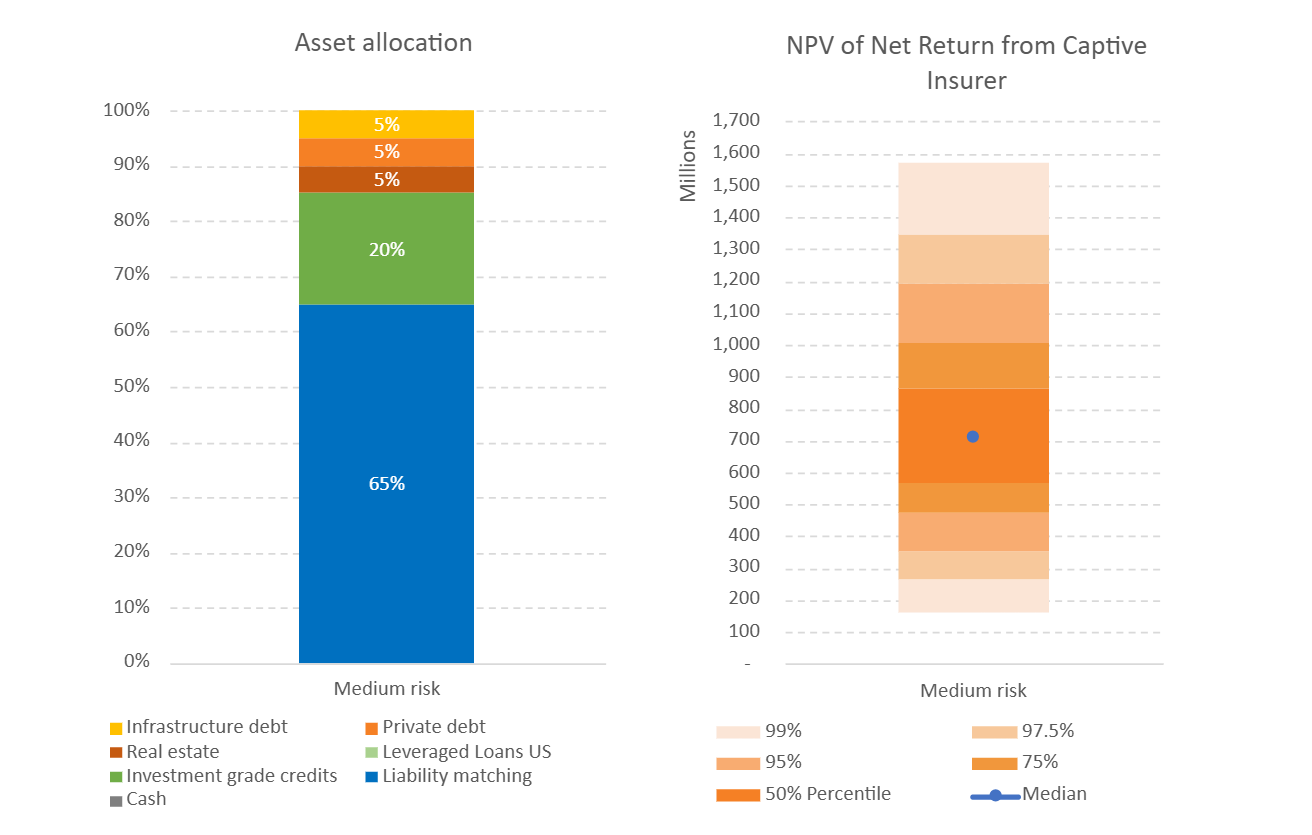
Scheme: The pension scheme in this study is 105% funded on a low-dependency basis of gilts+0.5% p.a. The liability value is £3bn on the same valuation basis.
- Captive insurance domicile: Bermuda
- Additional capital: We assume an extra £1bn of capital is held in surety bonds from inception to ensure the captive insurer’s solvency level is in line with its operating solvency target. This £1bn is modelled in our stochastic ALM tool (GLASS) as a separate balance sheet item. It is not invested and is used solely in the solvency calculation.
Surplus extraction rule:
- 100% of surplus is distributed back to the sponsor in the form of dividend payments when the Solvency Capital Ratio (SCR) is over 135% at the year-end; and
- The sponsor needs to provide sufficient capital to the captive insurer to bring the SCR back to 125% when it falls below.
Note that the NPVs shown exclude fronting insurer fees, captive set up costs, tax, and expenses. These items can vary significantly depending on factors such as captive size, investment approach, and domicile.
Given the sensitivity of outcomes to these assumptions—as well as differences in scheme design and stakeholder risk appetite—the results can vary significantly. This highlights the importance of performing a scheme specific stochastic ALM analysis to assess the value of a captive insurance solution for each case.
Our latest research paper uses GLASS (Ortec Finance’s ALM tool) to dive deeper into the analysis above, comparing multiple risk frameworks.
Interested to know more?
This article is the fourth in our series on rethinking the endgame for UK defined benefit pension schemes,
Download the whitepaper for a full comparison of endgame options where we evaluate the options using GLASS.
Or access the full series, here
Contact

Ashish Doshi
Head of Insurance and Asset Management
Selina Wang
Senior Consultant - Insurance Solutions
Ben Hudson
Senior ConsultantRelated Insights
-
 15 October 2026Self-service reporting from P&A systems: Shaping the future of performance and attribution
Learn why self-service reporting from performance measurement and attribution systems strikes the right balance between control, consistency and efficiency.
-
 06 October 2026Quarterly Scenario webinar Q4 2026 - 'A New Cost of Capital? What Higher Rates and Resilient Growth Mean for Investors'
Join our October 27 Q4 outlook webinar to explore the future path of yields, the cost of capital and what that mean for investors.
-
 01 October 2026Advancing towards an integrated assessment of climate risk: Bridging top-down and bottom-up climate models
Join our event, jointly hosted with MSCI, to learn more about a pioneering approach to integrating top-down and bottom-up climate models.
-
 28 September 2026How could this year’s extreme heat impact institutional investment portfolios?
Explore what the recent unprecedent heat could potentially mean for a pension fund and insurer’s investment portfolio as well as their total balance sheets.
-
 28 September 2026How the ‘advice continuum’ is changing the game
The advice continuum is reshaping wealth management, from targeted support to holistic planning at scale.
-
 24 September 2026Webinar recording: Funding ratio attribution for asset owners under higher interest rates
Learn how to develop a funding/solvency attribution that encompasses a comprehensive view of the fund’s performance
-
 21 September 2026AP7 selects Ortec Finance's performance measurement and attribution solution - PEARL
Learn about why AP7 has selected PEARL to measure and analyze investment performance across its global equity and fixed income portfolios
-
15 September 2026Measuring and attributing decisions within an Investment Decision Process
Learn about our approach to measuring investment decisions that enables asset owners to understand decision’s contribution to the total fund performance.
-
 14 September 2026Overcoming performance measurement challenges in private markets
Explore a more robust approach to measuring and attributing performance across private assets-related decisions to achieve consistency and transparency