

For a pension scheme looking to “run-on”, life will not be too dissimilar to how it has operated thus far – assets will continue to be invested by the scheme, and benefit payments will continue to be met by the scheme when they fall due.
There are however some key factors that Trustees and sponsors need to consider when going down the run-on road...
Surplus extraction:
- As surplus extraction becomes a more probable scenario, the surplus extraction framework will need to be designed, refined, and rigorously tested to provide decisionmakers with a comprehensive view of both upside and downside risks.
Risk exposures:
- Unlike an insurer buy-in/out, the scheme’s funding risks - such as investment risk, longevity risk, governance risk - remain with trustees and sponsors. Ongoing monitoring and mitigation will be essential to effectively manage these risks.
A run-on investment strategy offers flexibility to invest (or continue to invest) in illiquid assets. Risk modelling should be carried out to assess the liquidity required to meet future benefit cashflows. In fact, a cashflow driven type of investment strategy may still be appropriate.
The below illustrates a range of asset classes a scheme can invest in during the run-on period. The list is not exhaustive.
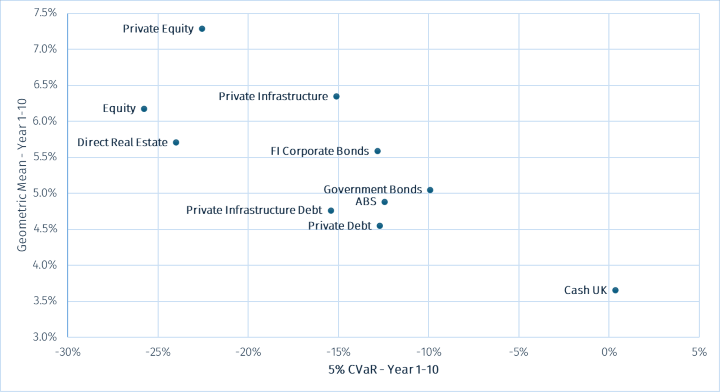
Source: Ortec Finance Scenarios
-
A surplus extraction framework
Extraction level:
- • What will be the measure that triggers the extraction of surplus. This is expected to be a funding level on a particular liability basis such as 110% on the low dependency basis.
- • A further prudent layer could be added such as "average funding level to be above 110% on the low dependency basis over the last 12 months" to allow for market volatility over the period.
Extraction rate:
- • The amount of surplus to be extracted can be set to be simply the excess amount above the extraction point.
- • Equally there could be a simmered approach where "50% of the excess above the extraction point in year 1, 60% of the excess above the extraction point in year 2..." And so on to ensure a buffer is built up to mitigate any downside risks.
Recovery contributions:
- • In the event of funding deterioration, recovery contributions can be built into the framework as a 'top up level' to protect against a growing deficit and ensure the benefits of scheme members.
- • Set up contribution rules to be conditional on the funding position at one specific point in time or based on an average over a specified period.
Surplus sharing:
- • The sponsor can take all of the surplus generated, or share part of the surplus with scheme members via discretionary indexation increases or direct member payments.
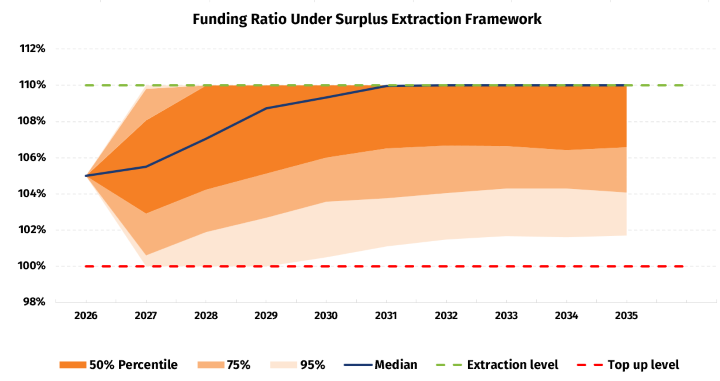
In the research paper linked to this blog, we projected forward multiple investment strategies over the next 10 years using stochastic scenarios to observe how they performed in relation to the key metrics that are of interest.
- Scheme: The pension scheme in this study is 105% funded on a low-dependency basis of gilts+0.5% p.a. The liability value is £3bn on the same valuation basis.
- Surplus extraction framework:
- Excess surplus is extracted when the funding ratio is over 110% on the low-dependency basis at the year-end; and
- A lump sum deficit contribution will be made if the funding ratio falls below 100% on the low-dependency basis, to bring the funding level back to 100%.
The charts below show one of the modelled investment strategies and the corresponding results of the cumulative Net Present Value (NPV) of net return (surplus extracted minus deficit contributions). This is a key metric a sponsor should be considering with this type of solution.
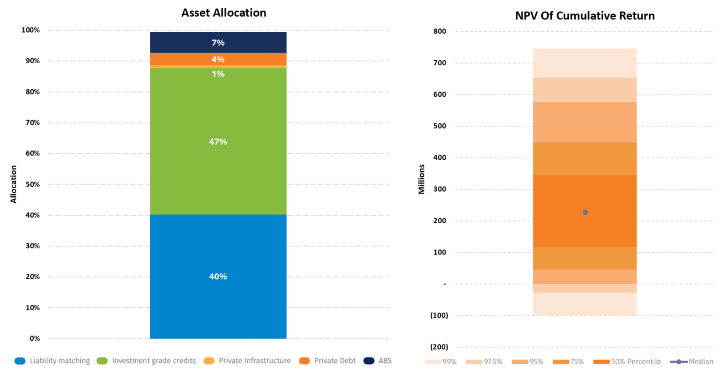
As part of the run-on framework, recovery contributions can be incorporated as an additional line of defense to protect any funding level deterioration. ALM tools can be used to assess the best ‘top-up level’ for a specific scheme and the use of stochastic modelling to understand the probability of requiring these contributions. The chart below shows the Net Present Value of deficit contributions required for a pensions scheme under the investment strategy outlined above.
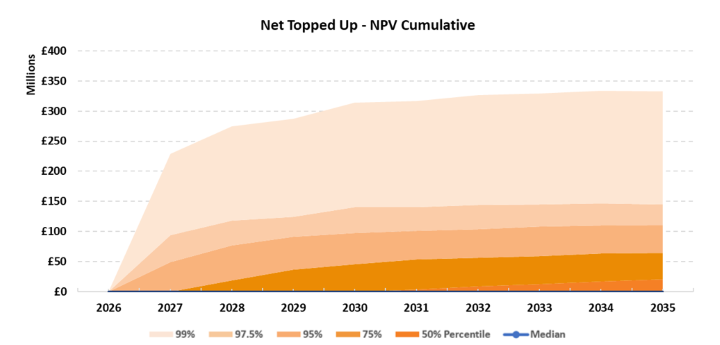
Given the sensitivity of outcomes to these assumptions-as well as differences in scheme design and stakeholder risk appetite-the results can vary significantly. This highlights the importance of performing a schemespecific stochastic ALM analysis to assess the value of a run-on solution for each case.
Our latest research paper uses GLASS (Ortec Finance’s ALM tool) to dive deeper into the analysis above, comparing multiple risk frameworks.
Interested to know more?
This article is the third in our series on rethinking the endgame for UK defined benefit pension schemes,
Download the whitepaper for a full comparison of endgame options where we evaluate the options using GLASS.
Or access the full series, here
Contact

Ashish Doshi
Head of Insurance and Asset Management
Selina Wang
Senior Consultant - Insurance Solutions
Ben Hudson
Senior ConsultantRelated Insights
-
 15 October 2026Self-service reporting from P&A systems: Shaping the future of performance and attribution
Learn why self-service reporting from performance measurement and attribution systems strikes the right balance between control, consistency and efficiency.
-
 06 October 2026Quarterly Scenario webinar Q4 2026 - 'A New Cost of Capital? What Higher Rates and Resilient Growth Mean for Investors'
Join our October 27 Q4 outlook webinar to explore the future path of yields, the cost of capital and what that mean for investors.
-
 01 October 2026Advancing towards an integrated assessment of climate risk: Bridging top-down and bottom-up climate models
Join our event, jointly hosted with MSCI, to learn more about a pioneering approach to integrating top-down and bottom-up climate models.
-
 28 September 2026How could this year’s extreme heat impact institutional investment portfolios?
Explore what the recent unprecedent heat could potentially mean for a pension fund and insurer’s investment portfolio as well as their total balance sheets.
-
 28 September 2026How the ‘advice continuum’ is changing the game
The advice continuum is reshaping wealth management, from targeted support to holistic planning at scale.
-
 24 September 2026Webinar recording: Funding ratio attribution for asset owners under higher interest rates
Learn how to develop a funding/solvency attribution that encompasses a comprehensive view of the fund’s performance
-
 21 September 2026AP7 selects Ortec Finance's performance measurement and attribution solution - PEARL
Learn about why AP7 has selected PEARL to measure and analyze investment performance across its global equity and fixed income portfolios
-
15 September 2026Measuring and attributing decisions within an Investment Decision Process
Learn about our approach to measuring investment decisions that enables asset owners to understand decision’s contribution to the total fund performance.
-
 14 September 2026Overcoming performance measurement challenges in private markets
Explore a more robust approach to measuring and attributing performance across private assets-related decisions to achieve consistency and transparency