

With more endgame options becoming available to UK DB pension schemes, it has become increasingly more challenging for Trustees to choose the right option. As a part of this decision-making process, Trustees and sponsors must consider a number of key factors that will help them to weigh up their options and is why there is no ‘one-size-fits-all’ option when it comes to endgame.
The endgame decision process:
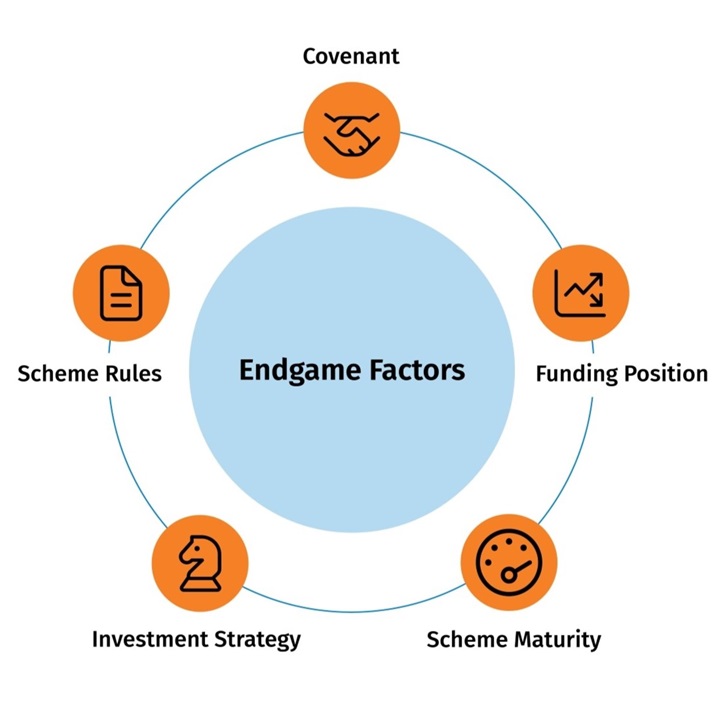
Funding Position |
An obvious consideration but a vital one, nonetheless. The funding position is the ‘health check’ of a pension scheme at a moment in time and hence can help distinguish the options available. However, looking at this statistic alone cannot offer much information of a scheme’s situation, as an underfunded scheme may look unhealthy, but for an underfunded scheme with an immature membership profile immediate decisions are not required. |
Scheme Maturity |
A more mature scheme can be much more attractive for insurers due to the low-risk nature of the liabilities, so cheaper transaction costs can often be seen in the bulk annuity market. Similarly, a mature scheme is likely to be cashflow negative, and therefore liquidity is one of the key considerations when designing the investment strategy. |
Investment Strategy |
Perhaps the most important factor influencing the endgame option is the current scheme’s investment strategy. Buy-out will require a highly liquid portfolio for insurers to take on, which will take time to evolve while run-on or a captive insurance arrangement can offer more flexibility. |
Scheme Rules |
Scheme specific rules can enforce restrictions on the endgame options, such as how surplus is distributed. Run-on will still be a consideration under this example, but it limits the surplus release opportunities. |
Covenant |
Representing the ability for the pension scheme to receive financial support from its sponsor, the scheme’s covenant can give an indication of what options are available to the scheme. Run-on will require a reasonable level of covenant to support the scheme. |
It is not possible to decide on the best endgame option from one of these factors alone; the Trustees and sponsor need to consider all factors as a collective. For example, a scheme with a poor funding position will still have multiple options available to them, however a scheme with a poor funding position and weak covenant suddenly has fewer options and can be limited to routes such as superfunds.
Quantifying these factors can lead to a better understanding of the future impact to the scheme under each endgame option. Stochastic ALM analysis allows pension schemes to play with these factors like toggles, zooming in on the most important factor to that scheme. Combining the current funding position, the investment strategy and the schemes maturity can help model how the endgame options compare to each other under various metrics like liquidity, probability of requiring deficit contributions and expected surplus generation.
In our recent whitepaper, we walk through case studies that use ALM analysis to take these factors into consideration.
Interested to know more?
This article is the fifth in our series on rethinking the endgame for UK defined benefit pension schemes,
Download the whitepaper for a full comparison of endgame options where we evaluate the options using GLASS.
Or access the full series, here
Contact

Ashish Doshi
UK Insurance Lead
Selina Wang
Senior Consultant - Insurance Solutions
Ben Hudson
Senior ConsultantRelated Insights
-
 06 October 2026Quarterly Scenario webinar Q4 2026 - 'A New Cost of Capital? What Higher Rates and Resilient Growth Mean for Investors'
Join our October 27 Q4 outlook webinar to explore the future path of yields, the cost of capital and what that mean for investors.
-
 01 October 2026Advancing towards an integrated assessment of climate risk: Bridging top-down and bottom-up climate models
Join our event, jointly hosted with MSCI, to learn more about a pioneering approach to integrating top-down and bottom-up climate models.
-
 28 September 2026How could this year’s extreme heat impact institutional investment portfolios?
Explore what the recent unprecedent heat could potentially mean for a pension fund and insurer’s investment portfolio as well as their total balance sheets.
-
 28 September 2026How the ‘advice continuum’ is changing the game
The advice continuum is reshaping wealth management, from targeted support to holistic planning at scale.
-
 24 September 2026Webinar recording: Funding ratio attribution for asset owners under higher interest rates
Learn how to develop a funding/solvency attribution that encompasses a comprehensive view of the fund’s performance
-
 21 September 2026AP7 selects Ortec Finance's performance measurement and attribution solution - PEARL
Learn about why AP7 has selected PEARL to measure and analyze investment performance across its global equity and fixed income portfolios
-
15 September 2026Measuring and attributing decisions within an Investment Decision Process
Learn about our approach to measuring investment decisions that enables asset owners to understand decision’s contribution to the total fund performance.
-
 14 September 2026Overcoming performance measurement challenges in private markets
Explore a more robust approach to measuring and attributing performance across private assets-related decisions to achieve consistency and transparency
-
 27 August 2026Total Portfolio Lens: A five-part webinar series
Learn how to apply the TPA approach without redesigning your entire investment model.