

With the UK Government’s new rent policy coming into force from 1 April 2026, housing associations face both an important opportunity and a significant governance responsibility: the re‑introduction of rent convergence.
Under the updated framework, providers are once again allowed to move social rent properties toward their formula rent where they currently sit below it. This has long been recognised as a robust and fair way to ensure consistency, sustainability, and transparency in rent-setting. But doing this accurately, and in a way that supports long-term financial resilience, requires a high-level of data detail that many organisations might struggle with.
Why UPRN-Level Data Changes Everything
Most financial planning tools on the market operate at an aggregated level, but rent convergence is inherently property‑specific. It relies on factors such as:
- A property’s derived formula rent,
- Bedroom weighting,
- Historic adjustments,
- Rent caps,
- Affordability constraints.
This makes UPRN-level modelling not just beneficial, but essential.
Because our planning tool holds granular data for every individual property, housing associations can model rent convergence with true precision. This eliminates the manual workarounds based on averaging and proxy assumptions, enabling a direct, transparent calculation for each unit, exactly as the government policy intended.
This level of detail provides a powerful governance benefit: you can demonstrate that any rent change, down to the individual home, is evidence-based, policy-aligned, and fully auditable.
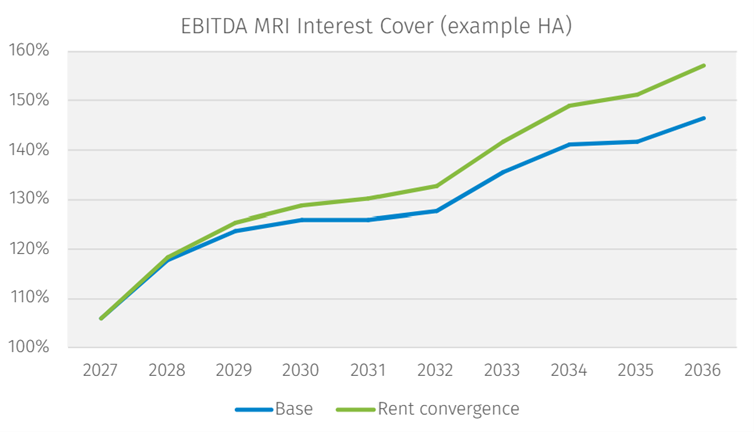
Figure: Rent Convergence Impact
For Financial Planners: Convergence Analysis Made Easy
While it might be simple to set-up an Excel sheet and do some first impact analysis, integrating the rent convergence into your financial plan is more complex. How do disposals impact the effect of rent convergence, how do you incorporate updated disposal data into your analysis, what is the effect across different tenures and entities? These questions already add layers of complexity. But not with our tool. In WALS it becomes more manageable and is fully embedded into your regular financial planning and stress-testing cycle.
What you can do instantly:
- Easily flag the units that fall under this new rent regime.
- Assign the new rent regime, rent caps and flexibility thresholds.
- Identify the convergence potential against current rent regimes.
- Model multiple scenarios: full or partial convergence.
- Assess financial impact on rental income, cash flows, and covenants.
- Compare your current rent regime with a policy-compliant convergence approach in just a few clicks.
Because analysis runs directly at unit level, planners can identify properties where convergence is significant, marginal, or impossible due to caps or local affordability. All results automatically aggregate into forecasts, business plans, and Board‑ready reporting.
For Boards & Executive Teams: A Governance Imperative
The regulator will expect clarity on:
- How rents are set,
- Whether they align with formula rent principles,
- The rationale behind flexibility, and
- How the association is ensuring fairness, compliance, and transparency.
Conducting this analysis at a high or averaged level won’t be sufficient. A board can only have confidence where the organisation can state:
“We understand the formula rent position for every property we own, and we can evidence exactly how we have applied policy at unit level.”
Our system makes this not only possible, but straightforward. Because all calculations are done at UPRN level, you gain:
- Full auditability: every rent, adjustment, and exception is traceable.
- Clear risk oversight: convergence uplift, affordability pressure, and local variation are visible at home-level detail.
- Better strategic decision-making: convergence can be aligned with wider asset strategy, decarbonisation investment, or targeted disposals.
The result is a rent-setting approach that is fair, defendable, and fully in line with national policy, providing reassurance for both the Regulator and for tenants.
Why This Matters Now
Rent policy from April 2026 is designed to provide at least 10 years of stability, creating a valuable window for long-term planning. Understanding rent convergence today helps you:
- Unlock potential rental income where justified,
- Future-proof financial forecasts,
- Strengthen business cases for investment, and
- Embed a policy-aligned rent regime that supports both financial health and tenant protection.
Because your data is already available at the most granular level, the heavy lifting is done. You can approach rent convergence not as a standalone project, but as a natural extension of your existing planning and stress-testing workflows.
More Insights About Financial Modelling For Social Housing
Dutch Social Housing Finance Under Pressure
Quarterly Economic Outlook for UK Housing Associations
Devolution, Delivery and Financial Reality: Lessons from Amsterdam’s Housing Partnerships
Get In Touch
If you would like to learn more about the benefits of WALS for your Housing Association, please contact David using the details provided below. He will be delighted to assist you.
Contact

David Kronbichler
Managing DirectorRelated Insights
-
 24 August 2026Quarterly Economic Outlook for UK Housing Associations
Discover how UK housing associations can navigate economic volatility with quarterly financial planning, regular updates on key macroeconomic indicators, and sector-specific insights to support informed decision-making in a changing environment. In this edition an update for Q3 2026.
-
 01 June 2026Ortec Finance publishes its first Sustainability report
Ortec Finance publishes its first Sustainability Report. It covers the reporting years 2024 and 2025.
-
 17 April 2026We’re Up & Running in the UK
Discover how WALS is transforming financial planning for UK housing associations with innovative, data-driven solutions, empowering smarter decisions and greater efficiency. Learn more now!
-
 24 February 2026Unlocking Rent Convergence: Why UPRN‑Level Insight Is Essential
Learn how UPRN-level data helps UK housing associations achieve fair rent convergence and strong financial planning.
-
17 February 2026Dutch Social Housing Finance Under Pressure
UK Social Housing can draw key lessons from Dutch trends: record-high operating costs, rising personnel expenses, and significant increases in home improvement investments point to mounting financial pressures for housing associations.
-
 29 January 2026Ortec Finance Continues Strong Client Satisfaction Scores in 2025 Survey
2025 annual customer satisfaction survey again confirms high levels of satisfaction.
-
 24 December 2025Devolution, Delivery and Financial Reality: Lessons from Amsterdam’s Housing Partnerships
Discover how Amsterdam’s housing associations and municipality use transparent financial assessments to set realistic, joint priorities for social housing investments: offering lessons in partnership, evidence-based planning, and sustainable delivery for the sector.
-
 17 November 2025Optimizing Real Estate valuation: insights gained from student research
Recently, we had the privilege of learning from a student’s thesis that explored advanced techniques in property valuation.
-
 11 September 2025Spring 2025 rent freeze proposal in Dutch social housing
Discover how the Dutch Spring 2025 rent freeze proposal sparked sector-wide resistance, legal challenges, and financial modeling that helped avert a crisis in social housing. Lessons learned for future resilience.