

Published by Dutch Housing Federation Aedes, the Aedes Benchmark 2025 provides a comprehensive overview of the performance of Dutch housing associations covering tenant satisfaction, finance, maintenance and retrofit, sustainability, new schemes, affordability, and livability.
With 96% of associations participating, the benchmark offers a robust, sector-wide perspective and serves as an important tool for transparency, peer learning, and continuous improvement.
Ortec Finance contributed to the benchmark by providing all results for the finance-related metrics. In this article, we share several insights into these financial metrics at the sector level. Additional (graphical) results are available in Dutch on the Aedes Benchmark website.
Controllable operating costs have reached record highs, driven mainly by rising personnel expenses
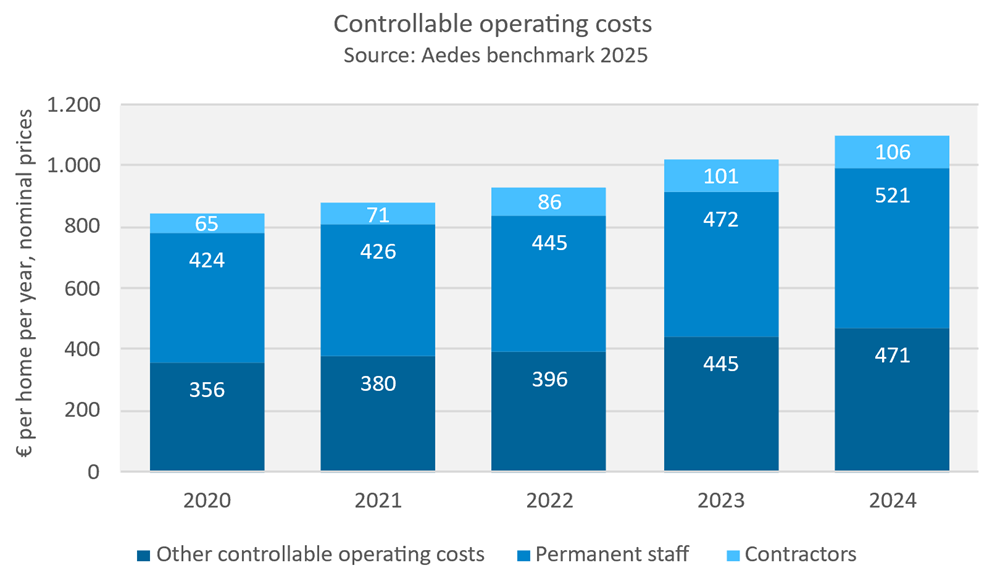
Operating costs have reached unprecedented levels. For the second consecutive year, controllable operating costs, those that associations can directly influence, such as personnel, ICT, housing, and insurance, have surpassed non-controllable costs like taxes and levies.
In 2025, controllable costs rose to €1,097 per home, the highest since the inception of the benchmark. This increase is driven primarily by personnel expenses, which grew from €573 to €627 per home, largely due to a 10% wage increase for permanent staff.
Although the use of external contractors remains necessary in a tight labour market, their share in total personnel costs has, for the first time in years, ceased to grow.
Investment in home improvements has risen more sharply than other maintenance-related expenditures
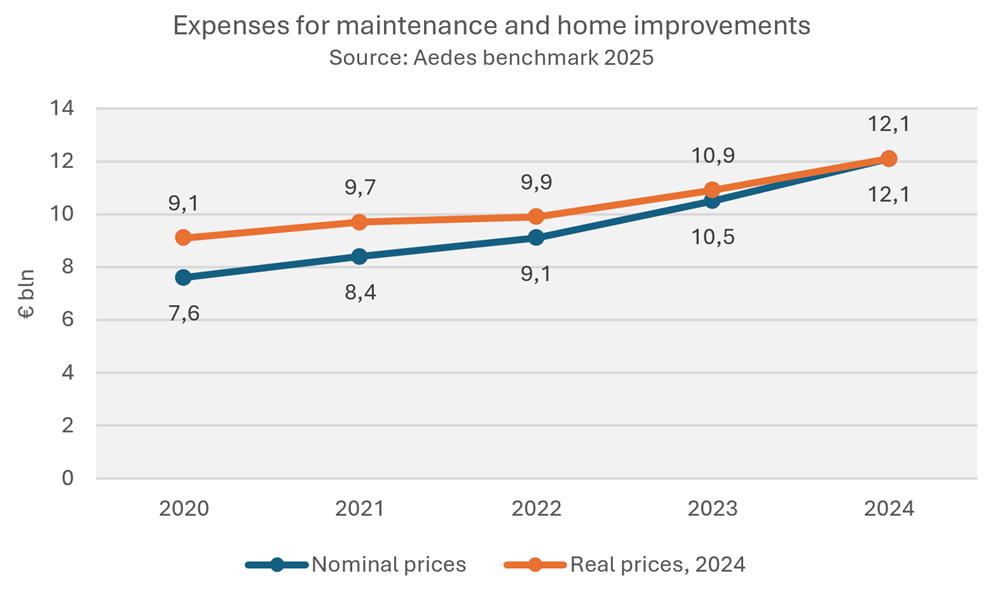
In 2024, housing associations spent €12.1 billion on maintenance, refurbishments and retrofitting for their existing homes. That is a 15.2% increase compared with 2023. Approximately 3.6% of this growth can be attributed to higher construction costs (inflation). The remaining increase, over 10% is because housing associations focused their priorities on upgrading their existing homes.
Operating cash flow falls short, resulting in increased deficits and a reliance on external financing and sales
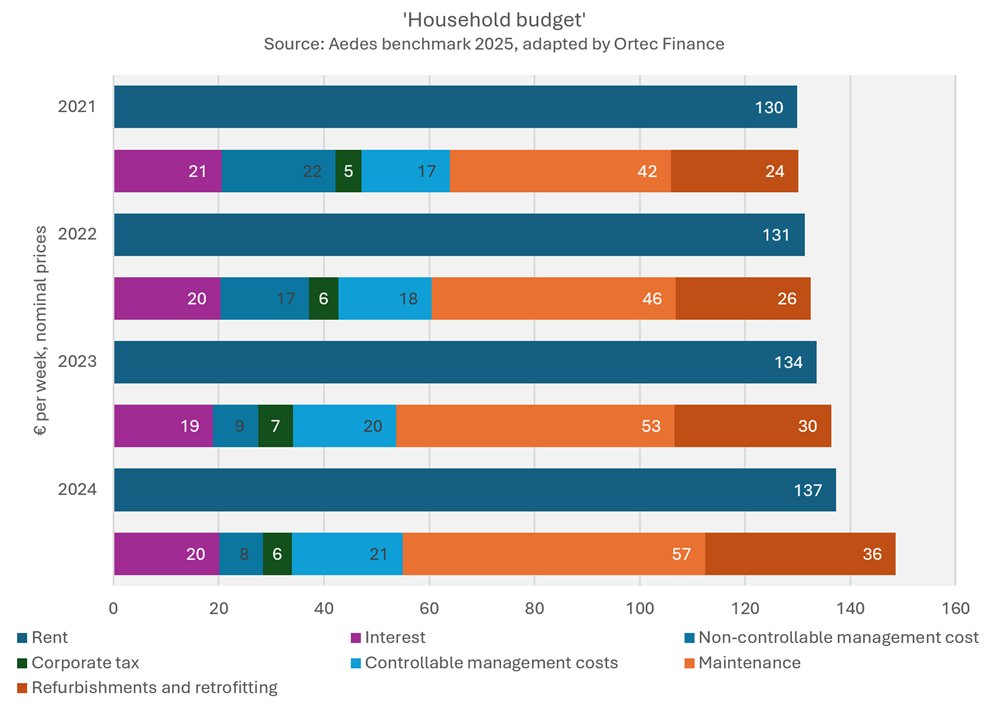
Because of rising costs, the sector’s operating cash flow is no longer sufficient to cover all ongoing expenses. The average weekly deficit per home has widened from €3 per week to €11, as spending on maintenance, refurbishments and retrofitting now outpaces net rental income after operating costs, interest, and taxes. This shortfall means that housing associations can no longer fully finance their activities from internal cash flow, let alone fund new schemes. As a result, they are increasingly relying on external financing and, to a lesser extent, the disposal of existing properties to bridge the gap.
Borrowing has surged dramatically, with over half of all investments now debt-funded, reflecting strong investment ambitions and constrained rental income growth.
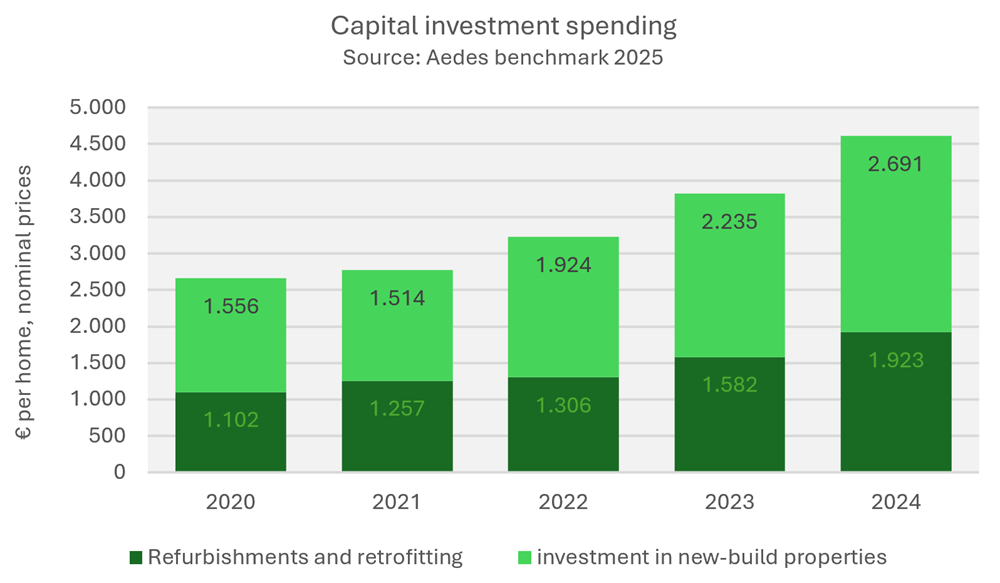
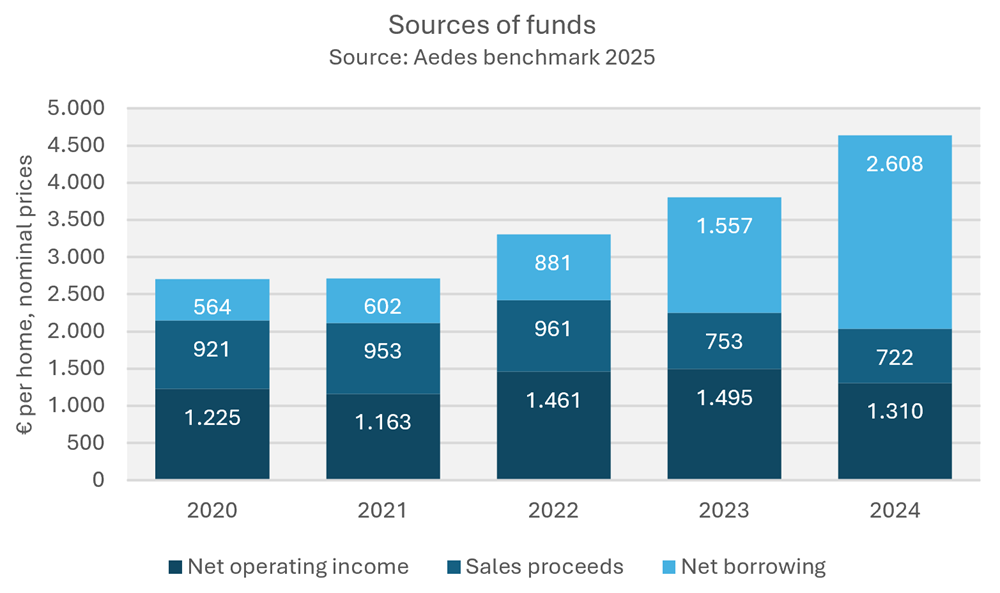
Investment by housing associations has increased steadily for many years, in line with the Dutch National Performance Agreements. An even larger share of this investment is financed through borrowing. Whereas in 2020 only 21% of newbuild and improvement expenditure was debt funded, by 2024 this had risen to 56%, meaning more than half are now financed with loans.
The graphs below illustrate the sources and uses of investment funds. Several points stand out:
- Housing associations have significantly increased their investment in recent years: an annual rise of €2 billion, which is 71% more than in 2020.
- Operating cash flow (net rental income) remains largely unchanged between 2020 and 2024, despite the abolition of the landlord levy. This reflects the fact that costs, particularly for maintenance and home improvement, are rising faster than rent.
- Sales proceeds have declined by 22%, even though house prices have risen sharply, by almost 40%. Associations are selling far fewer homes, possibly due to growing societal pressure on them to reduce sales.
- Consequently, the sector's loan portfolio has increased substantially between 2020 and 2024 in order to finance these higher investment levels.
Read our tips for Housing Association Finance professionals across the UK
- [Insight] Quarterly Economic Outlook for UK Housing Associations
- [Client Story] Devolution, Delivery and Financial Reality: Lessons from Amsterdams Housing Partnership
- [Blog] From Pressure to Precision: Financial Planning as a Strategic Compass
Want to know more about our Real Estate Financial Planning solutions
Please reach out to David using the details below -he’s happy to answer any questions.
Contact

David Kronbichler
Managing DirectorRelated Insights
-
 24 August 2026Quarterly Economic Outlook for UK Housing Associations
Discover how UK housing associations can navigate economic volatility with quarterly financial planning, regular updates on key macroeconomic indicators, and sector-specific insights to support informed decision-making in a changing environment. In this edition an update for Q3 2026.
-
 01 June 2026Ortec Finance publishes its first Sustainability report
Ortec Finance publishes its first Sustainability Report. It covers the reporting years 2024 and 2025.
-
 17 April 2026We’re Up & Running in the UK
Discover how WALS is transforming financial planning for UK housing associations with innovative, data-driven solutions, empowering smarter decisions and greater efficiency. Learn more now!
-
 24 February 2026Unlocking Rent Convergence: Why UPRN‑Level Insight Is Essential
Learn how UPRN-level data helps UK housing associations achieve fair rent convergence and strong financial planning.
-
17 February 2026Dutch Social Housing Finance Under Pressure
UK Social Housing can draw key lessons from Dutch trends: record-high operating costs, rising personnel expenses, and significant increases in home improvement investments point to mounting financial pressures for housing associations.
-
 29 January 2026Ortec Finance Continues Strong Client Satisfaction Scores in 2025 Survey
2025 annual customer satisfaction survey again confirms high levels of satisfaction.
-
 24 December 2025Devolution, Delivery and Financial Reality: Lessons from Amsterdam’s Housing Partnerships
Discover how Amsterdam’s housing associations and municipality use transparent financial assessments to set realistic, joint priorities for social housing investments: offering lessons in partnership, evidence-based planning, and sustainable delivery for the sector.
-
 17 November 2025Optimizing Real Estate valuation: insights gained from student research
Recently, we had the privilege of learning from a student’s thesis that explored advanced techniques in property valuation.
-
 11 September 2025Spring 2025 rent freeze proposal in Dutch social housing
Discover how the Dutch Spring 2025 rent freeze proposal sparked sector-wide resistance, legal challenges, and financial modeling that helped avert a crisis in social housing. Lessons learned for future resilience.