

Last December, the Bank of England (BoE) Prudential Regulation Authority (PRA) published Supervisory Statement 5/25, highlighting its concerns about the systemic risks that climate-related factors pose to banks and insurers. The PRA also set out its expectations that these institutions adopt a forward-looking, strategic, and ambitious approach to implementing the recommended actions on an ongoing basis.
What does PRA’s guidance mean for UK insurers’ investment, risk, and sustainability teams?
The PRA has stated that while climate risks are uncertain in both scale and timing, they are foreseeable to some extent. It notes all firms, no matter the size, may be significantly exposed to these risks, with the magnitude of the impact being particularly influenced by an institution’s business model and the geographical concentration of its balance sheet.
From a UK insurer’s total balance sheet perspective, it is important for investment, risk and sustainability teams to understand how the geographical distribution of assets within the investment portfolio shapes the insurer’s exposure to climate-related risks, as well as how physical climate risks could increase policy payouts, challenge insurability, and affect solvency ratios.
Assessing and managing climate risk exposure in line with PRA expectations
While an assessment should be undertaken irrespective of the size of the insurance company, the PRA expects insurers that are materially exposed to climate-related risks to make a greater investment in monitoring and managing those risks than firms that are less exposed. As climate risk is systemic, all insurance companies are expected to fall into this category, requiring them to place greater focus on establishing effective climate risk management frameworks to assess the resilience and vulnerabilities of their business model, including investment strategies.
For insurance companies with material exposure, the PRA states that climate scenario analysis is a key tool for identifying, quantifying and managing climate risks, and for conducting internal assessments for capital adequacy – Own Risk and Solvency Assessment (ORSA). This reflects the fact that the characteristics of climate-related risks make it impossible to rely solely on historical data and experience, which is generally the approach used to evaluate traditional risks such as inflation and interest rate risks.
The PRA further advises that assessments should be proportionate to the scale of the risks and their proximity, considering both time horizon and likelihood. For risks expected to emerge over a longer time horizon, narrative-based scenarios should be employed.
Additional guidance on climate scenario analysis
The PRA also emphasized a number of key focus areas for insurers.
-
Robust assessments
-
Real-world reflections
-
Sensitivity analyses
-
Reliable models
-
Overall risk integration
Robust ongoing assessments are necessary
As some climate-related risks are already materializing and are expected to intensify over time, insurers should conduct regular reviews of their risk identification and assessment processes. This ensures that evaluations of materiality remain current, grounded in the latest scientific evidence, and that no significant risks are overlooked.
Assessments should be realistic and reflect real-world conditions
Climate risk assessments should consider all material climate-related risks across a range of plausible future outcomes, including different combinations of transition risk drivers and levels of physical risk impacts, as well as central case scenarios representing the most likely outcomes.
Sensitivity analyses and stress-testing enhance existing risk management frameworks
Climate scenario analysis supplements standard scenario analysis and stress-testing toolkits by accounting for the uncertainty and systemic nature of climate risks and acknowledge that the magnitude and timing of future risks are shaped by actions taken today.
In addition, climate risk assessments should include scenario-based sensitivity analysis or reverse stress-testing to assess severe but plausible stress scenarios.
Climate scenarios should draw on reliable models and expertise
Insurers should take a structured approach to assessing each component of a climate scenario, including the development a narrative that incorporates climate science, financial expertise and quantitative models.
Overall portfolio risk considerations should include climate risk exposure
Insurers should manage climate-related risks that may emerge over short, medium, and long-term horizons, with the PRA expecting them to keep exposures within their defined risk appetites.
PRA guidance on managing physical, transition, and market-related risks
The PRA has also elaborated further on how insurers should specifically approach physical, transition, and market-related risks.
- Physical risks: Assessments should be geographically granular enough to capture changes in the frequency and intensity of (acute physical risk) extreme weather events as well as long-term shifts in precipitation and average temperatures.
- Transition risks: Insurers should assess exposures with sufficient sectoral detail to capture risk dynamics and severe impacts, and account for concentrations in transition-sensitive sectors, such as fossil fuels.
- Market risks: Insurers should recognize that future returns may be more volatile than historical experience due to climate risks, with variations across sectors, subsectors, or regions. They should also understand how traditional financial models, such as Economic Scenario Generators, account for climate-related risks.
How can Ortec Finance’s climate scenario analysis and asset liability management capabilities support UK insurers in adhering to the PRA’s guidance?
Ortec Finance has developed proprietary climate scenarios specifically for investment decision-making, helping insurance companies to measure, monitor, and manage portfolio climate risk, with results that can be integrated into traditional risk analysis and asset-liability management (ALM) platforms.
-
Effective modelling
-
Plausible scenarios
-
Informed detailed results
-
Total risk management
Comprehensive insights and effective modeling frameworks
These plausible narrative-based scenarios, quantify climate risks and opportunities across all macroeconomic variables and asset classes, sectors and regions. They are updated annually, continually reflecting the latest scientific evidence on physical climate risks as well as up-to-date market information and use modelling approaches that align with the IFoA-recommended logistic damage functions.
A broad range of plausible climate scenarios
The Ortec Finance Climate Scenarios cover a range of outcomes under different temperature pathways, including a highly ambitious but orderly low-carbon transition; resilience to sudden, climate-induced repricing in financial markets; high exposure to physical risks arising from limited policy action; and a future with no further policy action, triggering multiple climate tipping points and very severe physical risks.
Informed results to facilitate further recommended assessments and analyses
Leveraging Ortec Finance’s proprietary extreme weather modeling tool and Economic Scenario Generator, together with Cambridge Econometric’s globally recognized E3ME model, these scenarios deliver a real-world quantitative assessment of systemic physical, transition, and market pricing risks.
This assessment is further enhanced by qualitative insights, geographic heatmaps, and an in-depth breakdown of physical, transition, and market pricing impacts. Together, these elements enable insurers to understand the underlying views and assumptions behind each scenario, how the models have been applied, and to undertake further scenario-based sensitivity analyses.
Manage total portfolio risk exposure across an insurer’s investment horizon
In combination with Ortec Finance’s asset liability management solution GLASS, insurers can use the Ortec Finance Climate Scenarios to identify potential climate-related impacts of their portfolios on the full balance sheet and corresponding metrics, such as investment return, SCR and Solvency II ratio. By quantifying the climate impact on both regulatory capital and asset class returns within optimized portfolios against the same baseline the insurer can assess whether their overall risk exposure stays within their defined risk appetites across short, medium, and long-term investment horizons.
Looking ahead: Harnessing available tools and scenarios to align with the Bank of England’s expectations
Selecting the right climate scenarios, which allow quantified assessments of climate risks and can be integrated with traditional risk assessments, is essential for insurers to incorporate the Bank of England’s climate expectations into their risk management frameworks and to address their implications across the entire balance sheet.
Ortec Finance offers insurers an integrated economic and climate risk management tool through its proprietary GLASS asset-liability management software and ClimateMAPS – a climate scenario analysis solution. GLASS utilizes economic scenarios that incorporate climate change and works in combination with ClimateMAPS’ narrative-based climate scenarios to explore a wide variety of potential climate-related economic and financial market impacts. Together, they provide one of the most comprehensive risk management tools available to institutional investors globally.
Further reading: Translating the cost of climate change for the European insurance industry: 2025 update
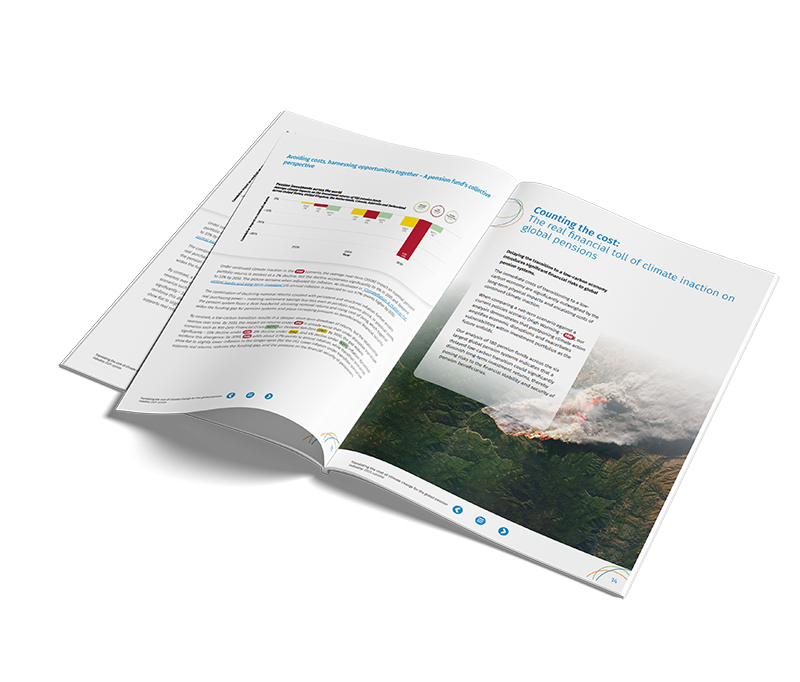
To learn more about how geographical differences in assets and liabilities affect the impact of physical risks on an insurer’s balance sheet, how rising physical risks compromise insurability, and how climate change affects different insurance lines, we invite you to read our annual climate risk analysis report. In the report, we explore the implications of climate change on short-term liabilities, investment targets, and the overall balance sheet for insurers.
More climate risk and sustainable finance insights
To receive the latest insights from our Climate Scenarios & Sustainability team on sustainable finance and climate risk management for financial institutions directly in your inbox, subscribe to our newsletter 'Radar'.

Contact

Job van der Wardt
Business Specialist Insurance
Bronwyn Claire
Head of Research and APAC Lead, Climate Scenarios & Sustainability
Koen de Reus
Head of Client Servicing, Climate Scenarios & SustainabilityRelated Insights
-
 15 October 2026Self-service reporting from P&A systems: Shaping the future of performance and attribution
Learn why self-service reporting from performance measurement and attribution systems strikes the right balance between control, consistency and efficiency.
-
 06 October 2026Quarterly Scenario webinar Q4 2026 - 'A New Cost of Capital? What Higher Rates and Resilient Growth Mean for Investors'
Join our October 27 Q4 outlook webinar to explore the future path of yields, the cost of capital and what that mean for investors.
-
 01 October 2026Advancing towards an integrated assessment of climate risk: Bridging top-down and bottom-up climate models
Join our event, jointly hosted with MSCI, to learn more about a pioneering approach to integrating top-down and bottom-up climate models.
-
 28 September 2026How could this year’s extreme heat impact institutional investment portfolios?
Explore what the recent unprecedent heat could potentially mean for a pension fund and insurer’s investment portfolio as well as their total balance sheets.
-
 24 September 2026Webinar recording: Funding ratio attribution for asset owners under higher interest rates
Learn how to develop a funding/solvency attribution that encompasses a comprehensive view of the fund’s performance
-
 21 September 2026AP7 selects Ortec Finance's performance measurement and attribution solution - PEARL
Learn about why AP7 has selected PEARL to measure and analyze investment performance across its global equity and fixed income portfolios
-
15 September 2026Measuring and attributing decisions within an Investment Decision Process
Learn about our approach to measuring investment decisions that enables asset owners to understand decision’s contribution to the total fund performance.
-
 14 September 2026Overcoming performance measurement challenges in private markets
Explore a more robust approach to measuring and attributing performance across private assets-related decisions to achieve consistency and transparency
-
 27 August 2026Total Portfolio Lens: A five-part webinar series
Learn how to apply the TPA approach without redesigning your entire investment model.